
| Download the amazing global Makindo app: ✅ Means NICE/National Guidelines 2026 compliant Android | Apple | |
|---|---|
| MEDICAL DISCLAIMER: Educational use only. Not for diagnosis or management. See below for full disclaimer. |
Exercise stress test
🫀 About
- The purpose of a cardiac stress test is to assess how the heart responds to increased workload, unmasking ischaemia or exercise-induced arrhythmias.
- Methods to increase myocardial oxygen demand include:
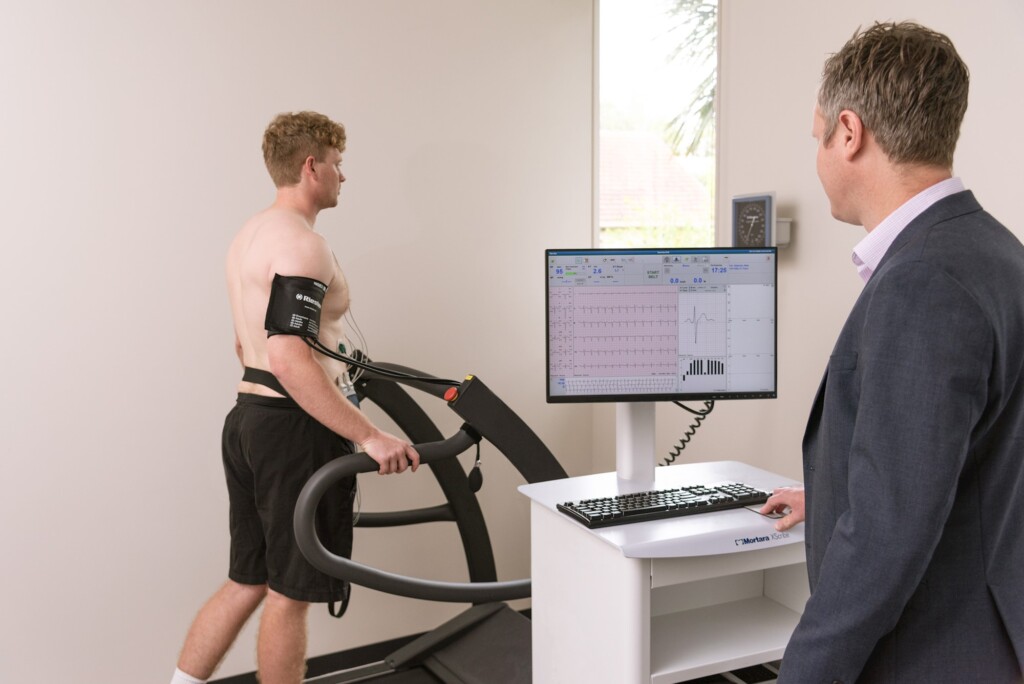
- Exercise Stress Test: Patient walks/runs on a treadmill with increasing incline/speed. ECG, blood pressure, and symptoms are monitored. May be combined with radionuclide scans (thallium, SPECT, PET).
- Dobutamine Stress Echocardiography: Used in those unable to exercise. Dobutamine infusion ↑ heart rate/contractility. Echo assesses regional wall motion changes as a marker of ischaemia.
- Stress testing can diagnose IHD, risk-stratify patients, guide need for angiography/revascularisation, and detect arrhythmias in a controlled setting.
📌 Indications
- Diagnostic: Suspected IHD, unexplained chest pain, or arrhythmias. May require stopping beta-blockers/antianginals for accurate IHD assessment.
- Prognostic: Post-MI evaluation, pre-operative cardiac risk, exercise capacity in heart failure, and detection of exercise-induced arrhythmias.
⚠️ Contraindications
- Absolute: Recent MI (<48 hrs), suspected unstable angina, severe aortic stenosis, acute pulmonary oedema, severe uncontrolled hypertension, dangerous arrhythmias, inability to exercise safely.
- Relative: Frailty, hypertrophic cardiomyopathy, significant fall risk.
- Non-Diagnostic Situations: LBBB, paced rhythm, complete heart block.
📝 Process
- Explain test, obtain consent, and ensure IV access/resus facilities if pharmacological stress is planned.
- Attach ECG leads (adjusted to torso), record baseline ECG, BP, HR.
- Exercise protocol: treadmill/bicycle with staged increases every 3 minutes. Monitor vitals at each stage.
- Target HR:
- Males → 220 − age
- Females → 210 − age
- Combine with radionuclide imaging if assessing perfusion:
- Fixed defect: infarction scar.
- Reversible defect: inducible ischaemia.
✅ Positive Test Indicators
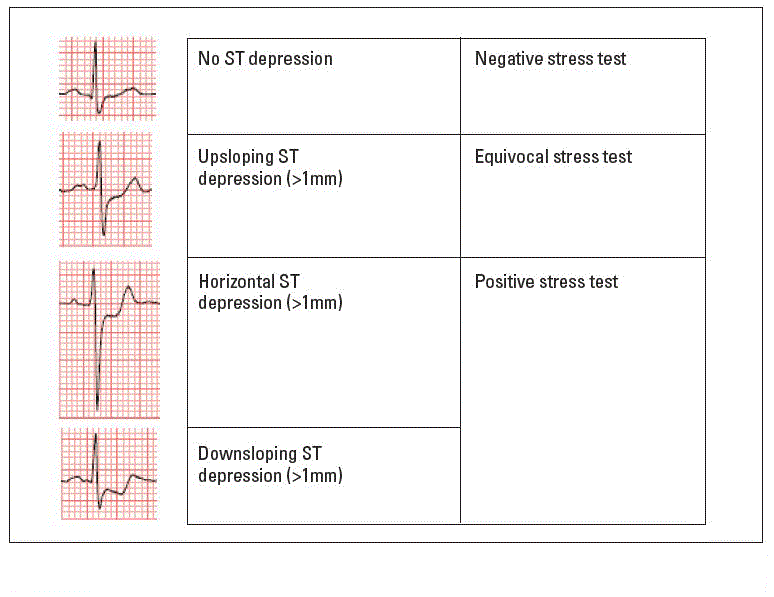
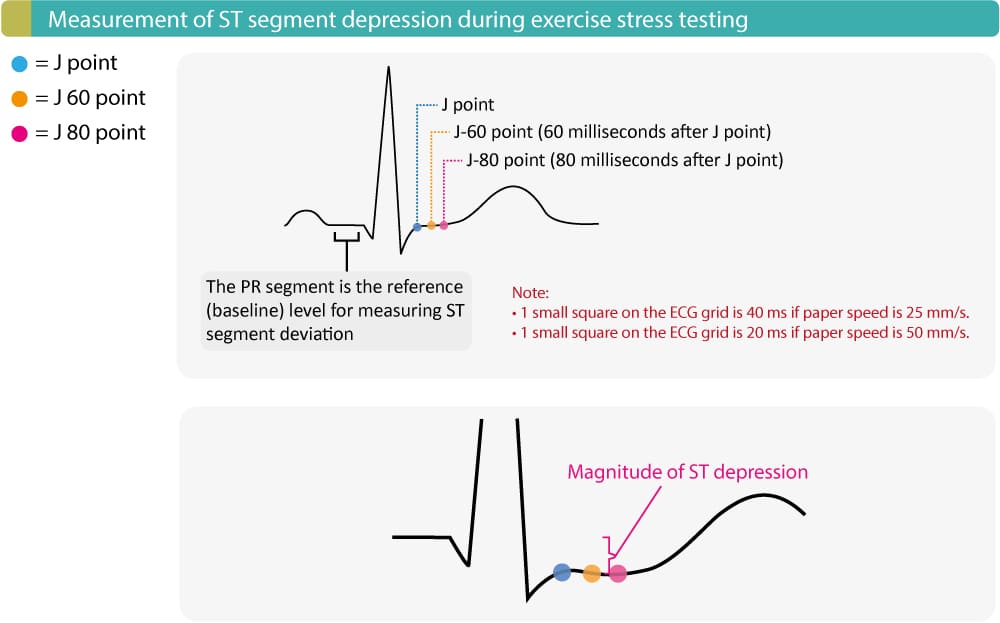
- Horizontal/downsloping ST depression ≥2 mm (esp. in V5).
- Exercise-induced chest pain corresponding to ECG changes.
- Fall in BP during exercise (poor prognostic sign).
- Low exercise tolerance with early onset of symptoms/ECG changes → worse outcome.
- Exercise-induced VT → mandates further cardiology workup.
💡 Teaching Pearls
- Stress tests are most useful in patients with intermediate pre-test probability of IHD (not very low or very high).
- ECG changes alone are less specific - coupling with imaging improves diagnostic accuracy.
- Always consider patient safety - stress tests can provoke significant ischaemia or arrhythmia → resuscitation facilities must be available.
| The content on this website is provided for educational and informational purposes only to support exam preparation (e.g., MLA, MRCP, USMLE) and learning. This is NOT medical advice, diagnosis, treatment, or professional guidance. It does not replace consultation with a qualified healthcare professional, official guidelines (e.g., NICE, GMC, BNF), or supervised clinical practice. Always verify information with current, authoritative sources. Makindo and its contributors accept no liability for any reliance on this content, including errors, omissions, or any resulting harm, loss, or consequences. By using this site, you agree to these terms. |
|
|
Categories
- About
- Acute Medicine
- Anaesthetics and Critical Care
- Anatomy
- Anatomy and Physiology
- Biochemistry
- Book
- Cardiology
- Collections
- CompSci
- Crib Sheets
- Critical care
- Dental
- Dermatology
- Differentials
- Drugs
- ENT
- Electrocardiogram
- Embryology
- Emergency Medicine
- Endocrinology
- Ethics
- Foundation Doctors
- GCSE
- Gastroenterology
- General Practice
- Genetics
- Geriatric Medicine
- Geriatrics
- Guidelines
- Haematology
- Hepatology
- Immunology
- Infectious Diseases
- Infographic
- Investigations
- Lists
- MRCP
- Mandatory Training
- Medical Students
- Microbiology
- Nephrology
- Neurology
- Neurosurgery
- Nutrition
- OSCE
- Obstetrics Gynaecology
- Oncology
- Ophthalmology
- Oral Medicine and Dentistry
- Orthopaedics
- Paediatrics
- Palliative
- Palliative Care
- Pathology
- Pharmacology
- Physiology
- Procedures
- Psychiatry
- Public Health
- Radiology
- Respiratory
- Resuscitation
- Revision Topics
- Rheumatology
- Statistics and Research
- Stroke
- Surgery
- Toxicology
- Trauma and Orthopaedics
- USMLE
- Urology
- Vascular Surgery