
| Download the amazing global Makindo app: ✅ Means NICE/National Guidelines 2026 compliant Android | Apple | |
|---|---|
| MEDICAL DISCLAIMER: Educational use only. Not for diagnosis or management. See below for full disclaimer. |
Cardiac Resynchronisation Therapy (CRT) Pacemaker
Related Subjects: Chronic Heart Failure | Heart Failure and Pulmonary Oedema | Loop Diuretics | Entresto Sacubitril with Valsartan | Ivabradine | Furosemide | Angiotensin Converting Enzyme Inhibitors | Cardiac Resynchronisation Therapy (CRT) Pacemaker |
❤️🩹 Cardiac Resynchronisation Therapy (CRT) improves symptoms, exercise tolerance, and quality of life, and reduces mortality in patients with moderate-to-severe symptomatic heart failure (NYHA III–IV), sinus rhythm, LVEF <35%, and LBBB with wide QRS.
ℹ️ About
- Also called biventricular pacing or pacing in heart failure.
- Aims to restore ventricular synchrony when the ventricles contract out of phase.
- Often combined with an implantable cardioverter-defibrillator (CRT-D) for patients at risk of malignant arrhythmias.
🩺 Aetiology / Rationale
- Ventricular dyssynchrony (esp. due to LBBB) worsens LV function by inefficient contraction.
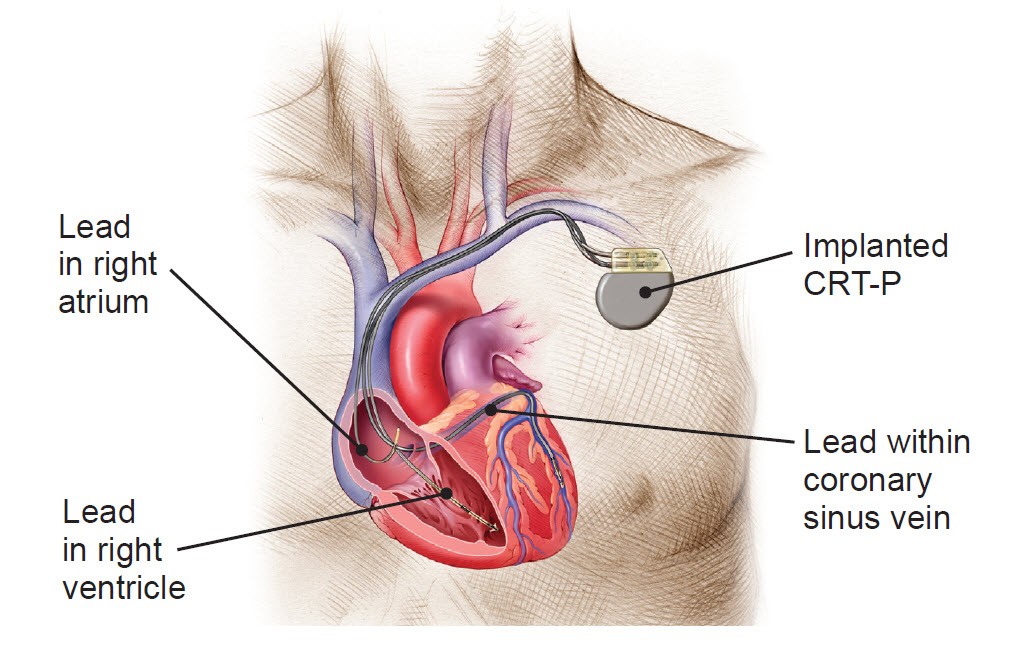
- CRT paces both ventricles ➝ coordinated contraction ➝ improved cardiac output.
- RV lead placed at apex, LV lead via coronary sinus to lateral LV wall.
- Resynchronisation helps prevent adverse remodelling of the failing LV.
✅ Indications for CRT
- NYHA III–IV heart failure despite optimal medical therapy.
- LVEF <35% with dilated LV.
- QRS >130 ms, esp. with LBBB morphology.
- In sinus rhythm (benefit in AF is less predictable).
📈 Effects & Mechanism
- Resynchronises ventricular contraction ➝ more efficient systolic function.
- Improves LV stroke volume and reduces mitral regurgitation by better papillary muscle coordination.
- Can promote reverse remodelling of dilated LV.
🌟 Clinical Benefits
- Improves exercise tolerance (6-minute walk distance, peak VO₂).
- Improves quality of life.
- Reduces heart failure hospital admissions.
- Reduces mortality in selected patients (e.g. CARE-HF, COMPANION trials).
💡 Teaching Pearl: Think of CRT when you see the triad of: 1️⃣ Symptomatic HF despite good medical therapy 2️⃣ LVEF <35% 3️⃣ Broad QRS with LBBB
| The content on this website is provided for educational and informational purposes only to support exam preparation (e.g., MLA, MRCP, USMLE) and learning. This is NOT medical advice, diagnosis, treatment, or professional guidance. It does not replace consultation with a qualified healthcare professional, official guidelines (e.g., NICE, GMC, BNF), or supervised clinical practice. Always verify information with current, authoritative sources. Makindo and its contributors accept no liability for any reliance on this content, including errors, omissions, or any resulting harm, loss, or consequences. By using this site, you agree to these terms. |
|
|
Categories
- About
- Acute Medicine
- Anaesthetics and Critical Care
- Anatomy
- Anatomy and Physiology
- Biochemistry
- Book
- Cardiology
- Collections
- CompSci
- Crib Sheets
- Critical care
- Dental
- Dermatology
- Differentials
- Drugs
- ENT
- Electrocardiogram
- Embryology
- Emergency Medicine
- Endocrinology
- Ethics
- Foundation Doctors
- GCSE
- Gastroenterology
- General Practice
- Genetics
- Geriatric Medicine
- Geriatrics
- Guidelines
- Haematology
- Hepatology
- Immunology
- Infectious Diseases
- Infographic
- Investigations
- Lists
- MRCP
- Mandatory Training
- Medical Students
- Microbiology
- Nephrology
- Neurology
- Neurosurgery
- Nutrition
- OSCE
- Obstetrics Gynaecology
- Oncology
- Ophthalmology
- Oral Medicine and Dentistry
- Orthopaedics
- Paediatrics
- Palliative
- Palliative Care
- Pathology
- Pharmacology
- Physiology
- Procedures
- Psychiatry
- Public Health
- Radiology
- Respiratory
- Resuscitation
- Revision Topics
- Rheumatology
- Statistics and Research
- Stroke
- Surgery
- Toxicology
- Trauma and Orthopaedics
- USMLE
- Urology
- Vascular Surgery