Related Subjects:
|Metabolic acidosis
|Lactic acidosis
|Acute Kidney Injury (AKI) / Acute Renal Failure
|Renal/Kidney Physiology
|Chronic Kidney Disease (CKD)
|Anaemia in Chronic Kidney Disease
|Analgesic Nephropathy
|Medullary Sponge kidney
|IgA Nephropathy (Berger's disease)
|HIV associated nephropathy (HIVAN)
|Balkan endemic nephropathy (BEN)
|Autosomal Dominant Polycystic kidney disease
🫘 Autosomal Dominant Polycystic Kidney Disease (ADPKD) is an inherited disorder causing progressive development of multiple fluid-filled renal cysts in both kidneys. It can cause hypertension, haematuria, loin pain, recurrent infection, renal stones and progressive chronic kidney disease. The key clinical priorities are early recognition, blood pressure control, kidney function monitoring, family counselling and identifying people at risk of rapid progression.
📖 About
- ADPKD is the most common inherited cause of chronic kidney disease.
- It is usually inherited in an autosomal dominant pattern, so an affected parent has a 50% chance of passing it to each child.
- Many people are asymptomatic for years and present in adulthood with hypertension, haematuria, loin pain or incidental renal cysts.
- Kidney size gradually increases as cysts expand, eventually compressing normal renal tissue.
- Progression is variable: some patients maintain good renal function for decades, while others develop kidney failure earlier.
🧬 Genetics & Aetiology
- PKD1 mutation: accounts for most cases and is associated with earlier onset and faster progression.
- PKD2 mutation: less common and usually associated with milder disease and later kidney failure.
- Polycystin-1 and polycystin-2: proteins involved in tubular structure, ciliary signalling and intracellular calcium regulation.
- Abnormal polycystin function leads to altered tubular cell signalling, increased cell proliferation, fluid secretion and cyst enlargement.
- New mutations can occur, so absence of a known family history does not fully exclude ADPKD.
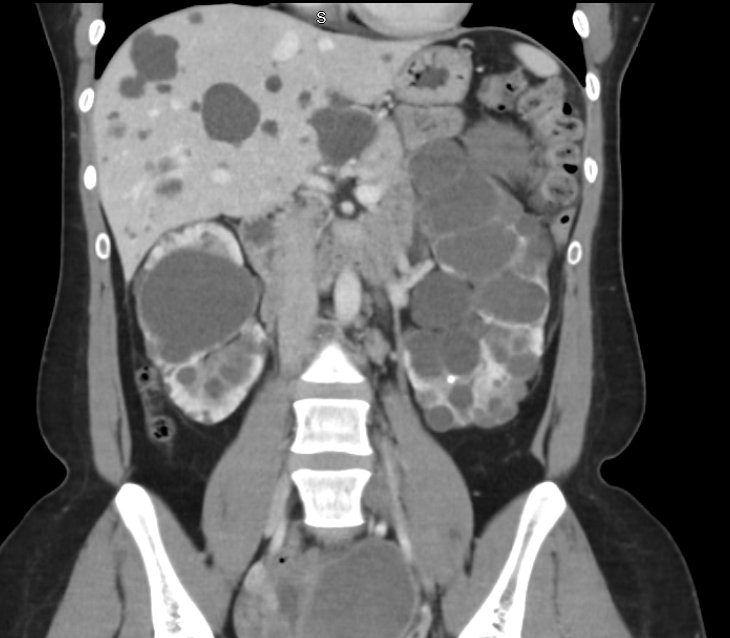
🔬 Pathophysiology
- 🫧 Cysts arise from renal tubular epithelial cells and gradually fill with fluid.
- 📈 Expanding cysts increase total kidney volume and compress surrounding normal renal parenchyma.
- 🩸 Renal ischaemia and activation of the renin–angiotensin–aldosterone system contribute to early hypertension.
- 🧪 Progressive nephron loss eventually causes chronic kidney disease and may lead to kidney failure.
- 🌍 ADPKD is systemic: cysts and connective tissue abnormalities can affect other organs.
🩺 Clinical Features
- 👨👩👧 Family history: kidney cysts, kidney failure, dialysis, transplant or early intracranial aneurysm.
- 🩸 Hypertension: often develops before major decline in eGFR and accelerates CKD progression.
- 🚽 Haematuria: microscopic or visible; may occur after cyst rupture, infection or stones.
- 🫘 Loin or abdominal pain: from cyst enlargement, haemorrhage, infection or stones.
- 🔥 Recurrent UTIs or cyst infection: fever, flank pain and raised inflammatory markers.
- 💎 Renal stones: commonly calcium oxalate or uric acid stones.
- 🌊 Polyuria/nocturia: impaired urinary concentrating ability can occur early.
- ⚖️ Progressive CKD: rising creatinine, falling eGFR, proteinuria usually mild unless another renal disease coexists.
🌍 Extra-Renal Manifestations
- 🫀 Liver cysts: common, especially with increasing age; usually asymptomatic but may cause abdominal distension or discomfort.
- 🧠 Intracranial aneurysms: increased risk, especially with family history of aneurysm or subarachnoid haemorrhage.
- ❤️ Cardiac valve disease: mitral valve prolapse and aortic regurgitation may occur.
- 🩸 Vascular disease: aortic root dilatation and arterial aneurysms are recognised associations.
- 🧱 Diverticular disease: more common, particularly in advanced CKD or dialysis patients.
- 🧬 Other cysts: pancreatic, seminal vesicle and arachnoid cysts may occur.
- 🤰 Pregnancy: hypertension and renal impairment increase maternal and fetal risk; specialist planning is advised.
🔎 Diagnosis
- Diagnosis is usually made by renal ultrasound in someone with a family history or suggestive clinical features.
- Ultrasound criteria depend on age and family history; a single simple renal cyst is common with ageing and does not diagnose ADPKD.
- CT or MRI can detect smaller cysts and estimate total kidney volume, which helps risk stratification.
- Genetic testing may be useful if imaging is equivocal, family history is unclear, or for family planning and living kidney donor assessment.
📊 Ultrasound Criteria in At-Risk Adults
| Age |
Typical ultrasound threshold suggesting ADPKD |
| 15–39 years |
≥3 renal cysts total, unilateral or bilateral |
| 40–59 years |
≥2 cysts in each kidney |
| ≥60 years |
≥4 cysts in each kidney |
🧪 Investigations
- Blood pressure: clinic and/or ambulatory monitoring; hypertension is common and treatable.
- Bloods: U&E, creatinine/eGFR, bicarbonate, calcium/phosphate, FBC, HbA1c/lipids if cardiovascular risk assessment needed.
- Urine: dipstick for blood/protein, urine ACR, urine culture if infection suspected.
- Renal ultrasound: first-line imaging for cyst burden and kidney size.
- CT/MRI: useful for complications, unclear diagnosis, stones, cyst haemorrhage, infection, or total kidney volume assessment.
- MR angiography: consider if intracranial aneurysm screening is indicated.
- Genetic testing: consider for uncertain diagnosis, young at-risk relatives, potential kidney donors or reproductive counselling.
🧠 Intracranial Aneurysm Screening
- Routine screening of every patient with ADPKD is not always performed.
- Consider MR angiography if there is a family history of intracranial aneurysm or subarachnoid haemorrhage.
- Also consider screening before major elective surgery, high-risk occupations, previous aneurysm, or significant patient anxiety after counselling.
- Give urgent advice for possible subarachnoid haemorrhage: sudden “thunderclap” headache, collapse, meningism, vomiting or neurological deficit.
⚕️ Management
- 🎯 No definitive cure: management focuses on slowing progression and treating complications.
- 🩸 Blood pressure control: treat hypertension early; ACE inhibitors or ARBs are commonly used first-line, particularly with albuminuria or CKD.
- 💧 Hydration: encourage healthy fluid intake unless contraindicated by advanced CKD, heart failure or other comorbidity.
- 🚭 Lifestyle: stop smoking, maintain healthy weight, reduce salt intake, exercise, and manage cardiovascular risk.
- 💊 Avoid nephrotoxins: avoid unnecessary NSAIDs and review contrast exposure carefully.
- 🔥 Infection: treat UTIs promptly; suspected cyst infection may need specialist imaging and longer antibiotic courses.
- 💎 Stones: assess with imaging and manage according to stone type, obstruction and infection risk.
- 🩺 CKD care: monitor eGFR, ACR, BP, anaemia, bone-mineral parameters and cardiovascular risk.
- 🧬 Genetic counselling: discuss inheritance, family screening, reproductive options and implications for relatives.
- 🫘 Kidney failure: dialysis or kidney transplantation; transplant outcomes are generally good in ADPKD.
💊 Tolvaptan - NICE / UK Context
- Tolvaptan is a vasopressin V2 receptor antagonist that can slow cyst growth and decline in kidney function in selected adults.
- NICE recommends tolvaptan only for adults with ADPKD who have CKD stage 2 or 3 at the start of treatment and evidence of rapidly progressing disease.
- It is usually initiated and monitored by a specialist renal team.
- Important adverse effects include thirst, polyuria, nocturia and risk of liver injury, so liver function monitoring is required.
- Not every patient with ADPKD is suitable; risk stratification may use age, eGFR decline, genotype, family history and total kidney volume.
🚩 Complications Requiring Urgent Review
- 🚽 Visible haematuria that is heavy, persistent or associated with clots.
- 🔥 Fever with loin pain suggesting pyelonephritis or cyst infection.
- 💎 Severe colicky pain suggesting renal stone or obstruction.
- 🧠 Thunderclap headache or neurological symptoms suggesting subarachnoid haemorrhage.
- 🤰 Pregnancy with hypertension, proteinuria or renal impairment.
- 📉 Rapid fall in eGFR or new heavy proteinuria, which may suggest another renal pathology.
👨👩👧 Family Screening & Counselling
- Adult first-degree relatives can be offered counselling and testing if they wish to know their status.
- Testing children is more nuanced and should involve discussion of benefits, harms and family preferences.
- Potential living kidney donors from affected families need careful imaging and sometimes genetic testing.
- Discuss implications for insurance, employment, psychological wellbeing and reproductive planning.
📝 Key Clinical Pearls
- 🩸 Think ADPKD in a young or middle-aged patient with hypertension plus family history of kidney disease.
- 🫘 Bilateral enlarged cystic kidneys are classic, but early disease may be subtle.
- 💥 Loin pain plus haematuria can be due to cyst haemorrhage or stone disease.
- 🧠 Berry aneurysm risk matters most when there is a family history of aneurysm or subarachnoid haemorrhage.
- 💊 ACE inhibitors or ARBs are commonly used for hypertension in ADPKD and CKD.
- 🧪 Tolvaptan is specialist-led and reserved for selected adults with evidence of rapid progression.
- 🧬 Each child of an affected parent has a 50% risk of inheriting the condition.
🧠 Teaching Note
ADPKD is not simply “lots of cysts”: it is a disorder of tubular cell signalling and ciliary function.
Polycystin dysfunction alters calcium signalling, promoting tubular proliferation and fluid secretion into cysts.
As cysts enlarge, they increase kidney volume, compress normal parenchyma and activate RAAS, explaining why hypertension often appears before severe loss of eGFR.
This is why early blood pressure control and specialist risk stratification are central to management.
📚 References & UK Resources