
| Download the amazing global Makindo app: ✅ Means NICE/National Guidelines 2026 compliant Android | Apple | |
|---|---|
| MEDICAL DISCLAIMER: Educational use only. Not for diagnosis or management. See below for full disclaimer. |
Vitamin C deficiency (Scurvy)
⚠️ Vitamin C requirements are increased by fever, inflammation, diarrhoea, smoking 🚬, hyperthyroidism, iron deficiency, cold or heat stress ❄️🔥, surgery, burns, and protein deficiency.
🧾 About
- Always check BNF (or equivalent) for prescribing advice.
- Scurvy is the clinical syndrome from dietary deficiency of vitamin C (ascorbic acid).
- Humans cannot synthesise vitamin C and depend entirely on diet.
📜 History
- Scurvy was a limiting factor in long sea voyages, often killing many sailors after 2–3 months at sea.
- In 1747, James Lind showed that scurvy could be cured with citrus fruits 🍋.
- Ascorbic acid was first isolated by Albert Szent-Györgyi in 1928 (Nobel Prize 1937 🏅).
⚙️ Aetiology & Function
- Vitamin C is an electron donor / reducing agent.
- Provides antioxidant protection against oxidative stress & UV-induced photodamage 🌞.
- Essential co-factor for proline & lysine hydroxylases, stabilising collagen structure.
- Promotes collagen gene expression ➡️ affects dentine, osteoid, and vessel wall tissues.
🩺 Clinical Features of Scurvy
- Mood: apathy, irritability, depression.
- Oral: swollen, bleeding gums, friability, infection, loose teeth 🦷.
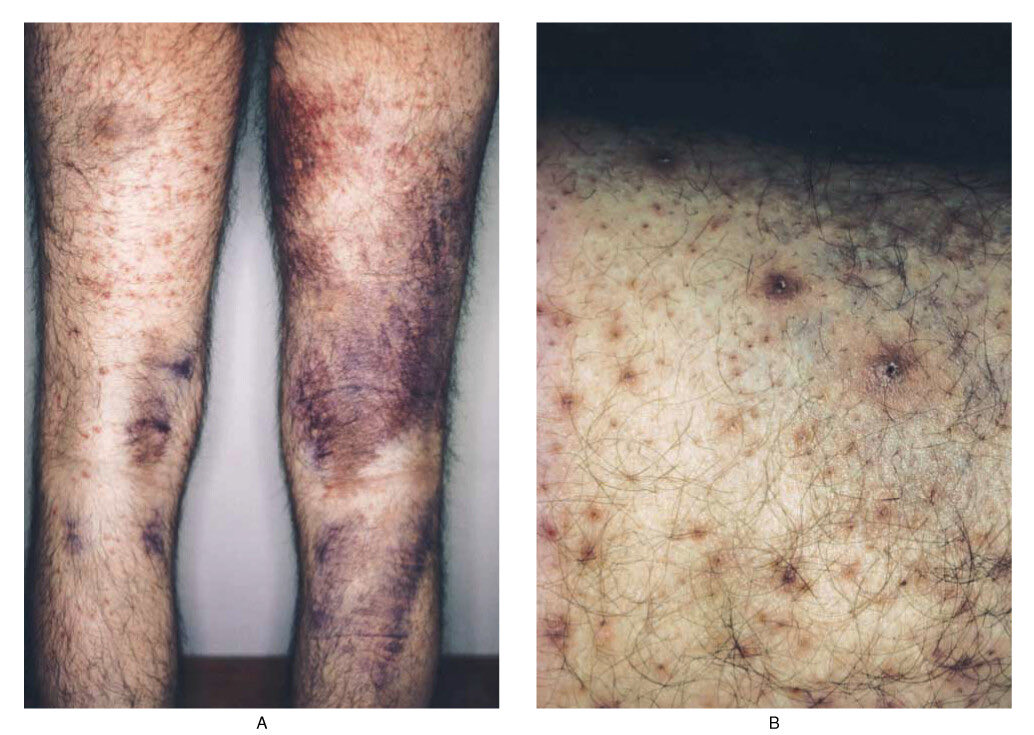
- Skin: perifollicular hyperkeratotic papules, perifollicular haemorrhages, purpura & ecchymoses.
- Ocular: scleral icterus (late, due to haemolysis).
- Musculoskeletal: bone pain, fractures, dislocations in children; bleeding into joints and muscles.
🔍 Differentials
- Gingivitis & periodontal disease.
- Haemorrhagic disorders (platelet/coagulation defects).
- Connective tissue diseases (e.g. Ehlers–Danlos, osteogenesis imperfecta).
- Protein-energy malnutrition.
🧪 Investigations
- FBC: may show anaemia (normocytic or macrocytic).
- Plasma vitamin C levels: <0.2 mg/dL (<11 µmol/L) indicate deficiency (not commonly tested).
💊 Management
- Scurvy is most common in alcoholics and the elderly consuming <10 mg/day vitamin C.
- Treatment: Ascorbic acid 100–500 mg PO TDS for 1–2 weeks, then maintenance long-term (BNF guidance).
- Dietary: 5 servings of fruit/veg daily provide >200 mg/day 🍊🥦🥭.
📚 References
🧾 Clinical Case Examples – Scurvy (Vitamin C Deficiency)
Case 1 – Child with Bleeding Gums 🧒🪥 A 6-year-old boy from a refugee camp presents with painful swollen gums, easy bruising, and poor wound healing. His diet is low in fruit and vegetables. On exam: bleeding gums, petechiae, and corkscrew hairs. 👉 Diagnosis: Scurvy. 👉 Management: Oral vitamin C supplementation, dietary education.
Case 2 – Elderly Malnourished Man 👴🍵 A 72-year-old widower with poor dentition and an alcohol history presents with fatigue, leg pain, and perifollicular haemorrhages. He reports eating mostly tea and bread. Bloods show mild anaemia. 👉 Diagnosis: Scurvy due to poor diet. 👉 Management: Vitamin C replacement, nutritional support, social input.
Case 3 – Dialysis Patient with Bone Pain 💉🦴 A 45-year-old man on long-term haemodialysis presents with bone tenderness, ecchymoses, and recurrent infections. Dietary history reveals avoidance of fresh produce. 👉 Diagnosis: Scurvy secondary to dietary restriction in chronic kidney disease. 👉 Management: Vitamin C supplementation (with renal dietician advice).
| The content on this website is provided for educational and informational purposes only to support exam preparation (e.g., MLA, MRCP, USMLE) and learning. This is NOT medical advice, diagnosis, treatment, or professional guidance. It does not replace consultation with a qualified healthcare professional, official guidelines (e.g., NICE, GMC, BNF), or supervised clinical practice. Always verify information with current, authoritative sources. Makindo and its contributors accept no liability for any reliance on this content, including errors, omissions, or any resulting harm, loss, or consequences. By using this site, you agree to these terms. |
|
|
Categories
- About
- Acute Medicine
- Anaesthetics and Critical Care
- Anatomy
- Anatomy and Physiology
- Biochemistry
- Book
- Cardiology
- Collections
- CompSci
- Crib Sheets
- Critical care
- Dental
- Dermatology
- Differentials
- Drugs
- ENT
- Electrocardiogram
- Embryology
- Emergency Medicine
- Endocrinology
- Ethics
- Foundation Doctors
- GCSE
- Gastroenterology
- General Practice
- Genetics
- Geriatric Medicine
- Geriatrics
- Guidelines
- Haematology
- Hepatology
- Immunology
- Infectious Diseases
- Infographic
- Investigations
- Lists
- MRCP
- Mandatory Training
- Medical Students
- Microbiology
- Nephrology
- Neurology
- Neurosurgery
- Nutrition
- OSCE
- Obstetrics Gynaecology
- Oncology
- Ophthalmology
- Oral Medicine and Dentistry
- Orthopaedics
- Paediatrics
- Palliative
- Palliative Care
- Pathology
- Pharmacology
- Physiology
- Procedures
- Psychiatry
- Public Health
- Radiology
- Respiratory
- Resuscitation
- Revision Topics
- Rheumatology
- Statistics and Research
- Stroke
- Surgery
- Toxicology
- Trauma and Orthopaedics
- USMLE
- Urology
- Vascular Surgery