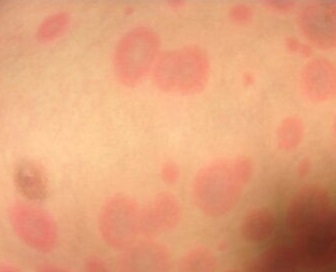
Erythema Multiforme ✅
Related Subjects:
| Nikolsky's sign
| Koebner phenomenon
| Erythema Multiforme
| Pyoderma gangrenosum
| Erythema Nodosum
| Dermatitis Herpetiformis
| Lichen Planus
| Acanthosis Nigricans
| Acne Rosacea
| Acne Vulgaris
| Alopecia
| Vitiligo
| Urticaria
| Basal Cell Carcinoma
| Malignant Melanoma
| Squamous Cell Carcinoma
| Mycosis Fungoides (Sezary Syndrome)
| Xeroderma Pigmentosum
| Bullous Pemphigoid
| Pemphigus Vulgaris
| Seborrheic Dermatitis
| Pityriasis/Tinea Versicolor Infections
| Pityriasis Rosea
| Scabies
| Dermatomyositis
| Toxic Epidermal Necrolysis
| Stevens-Johnson Syndrome
| Atopic Eczema/Atopic Dermatitis
| Psoriasis
🎯 Erythema Multiforme (EM) is an acute, self-limiting, type IV hypersensitivity skin reaction.
🦠 Trigger: 90% are triggered by infections (70% are HSV). Drugs are a rare cause (<10%).
⚠️ NICE/BAD Note: EM is now considered distinct from SJS/TEN. EM rarely progresses to SJS.
ℹ️ Pathophysiology
- Mechanism: Cell-mediated immune reaction against keratinocytes expressing foreign (viral or drug) antigens.
- Classification:
- EM Minor: Skin involvement only; no or minimal mucosal involvement.
- EM Major: Involvement of one or more mucosal sites (oral, genital, or ocular).
🩺 Clinical Features (The "Three-Zone" Rule)
- True Target Lesions: Must have 3 distinct zones:
- Center: Dusky, blistered, or crusty (dark).
- Middle: Paler pink/edematous ring.
- Outer: Bright red erythematous margin.
- Distribution: Symmetrical and centripetal (starts on backs of hands/feet and spreads toward the trunk).
- The "Fixed" Rule: Unlike urticaria, EM lesions stay in the same place for 7 days+ and do not "migrate."
- Mucosal (EM Major): Painful erosions/bullae. Check the eyes-ocular involvement is a medical emergency.
🦠 Common Triggers
- Viral (Most Common): Herpes Simplex (HSV-1 & 2) is the #1 cause. Often appears 10–14 days after the cold sore.
- Bacterial: Mycoplasma pneumoniae (often presents with severe mucosal involvement/EM Major).
- Drugs (Rare for EM): NSAIDs, Sulfonamides, Antiepileptics, Penicillins. (If drug-induced, consider if it's actually SJS).
🔍 Differentials (NICE Red Flags)
| Condition |
Distinguishing Feature |
| Urticaria |
Lesions are itchy, "wheal and flare," and disappear within 24 hours (transient). |
| SJS / TEN |
Skin pain is disproportionate to the rash; positive Nikolsky sign (skin peels with pressure); mostly trunk/face. |
| Granuloma Annulare |
Chronic, no "target" center, usually ring-shaped nodules on hands. |
💊 Management (NICE/BAD Guidance)
- Supportive: Most cases resolve in 2–4 weeks without treatment.
- Symptomatic:
- Topical steroids (mild/moderate potency) for itch.
- Antihistamines (non-sedating during day, sedating at night).
- Antiseptic/anaesthetic mouthwashes (e.g., Difflam) for oral EM Major.
- Specific Treatment:
- HSV: Oral Aciclovir does not treat the current EM but is used for prophylaxis if the patient gets >5 episodes of HSV-EM per year.
- Mycoplasma: Treat with Macrolides (e.g., Clarithromycin) if active pneumonia.
⚠️ When to Refer (Urgent)
- Ophthalmology: Any eye involvement (redness, pain, discharge) requires immediate same-day review to prevent scarring/blindness.
- Dermatology: If diagnosis is uncertain, lesions are bullous (blistering), or there is extensive mucosal involvement.
📌 Clinical Tips
- Tip 1: Always check the mouth, eyes, and genitals in any patient with a target-like rash.
- Tip 2: If the lesions are itchy, it’s more likely to be EM; if the skin is exquisitely painful to the touch, think SJS.
- Tip 3: A biopsy is rarely needed for EM-the diagnosis is almost always clinical based on the "three-zone" target.
📚 References