
| Download the amazing global Makindo app: ✅ Means NICE/National Guidelines 2026 compliant Android | Apple | |
|---|---|
| MEDICAL DISCLAIMER: Educational use only. Not for diagnosis or management. See below for full disclaimer. |
Carotid sinus massage
⚠️ Always assess stroke risk before CSM - exclude carotid stenosis with Doppler ultrasound first. Perform in a monitored setting with full resuscitation backup.
📖 About
- Requires a quiet, warm room 🌡️
- Attach ECG 📈 and BP monitoring equipment
- Resuscitation equipment at hand 🛟
🛠️ Technique
- Apply gentle pressure to the right carotid sinus for ~5 seconds
- Observe for HR and BP changes
- Repeat on the left carotid
- Repeat with patient tilted to 70° (upright) ↔️
📊 Monitoring
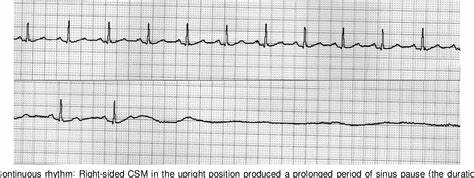
- Positive = pause ≥3 sec (cardioinhibitory) ⚡ OR systolic BP drop ≥50 mmHg (vasodepressor)
- Mixed type shows both responses
⚠️ Cautions
- Small risk of stroke/TIA → avoid if recent event or significant carotid stenosis 🚫
- Avoid in recent MI ❤️ or significant arrhythmias
- Drugs (digoxin, diltiazem, beta-blockers) may exaggerate sensitivity 💊
- Consider repeating test off drugs if safe
🛟 Immediate Management (if syncope)
- Lay patient flat 🛏️
- Raise legs 🦵 to improve cerebral perfusion
- Give oxygen if hypoxic
💡 Clinical Pearl:
CSM should only be done in a controlled setting.
A “positive” test (pause ≥3 sec or BP drop ≥50 mmHg) + reproduction of symptoms = diagnostic.
📚 Case Example
👴 An 82-year-old man with recurrent unexplained falls undergoes CSM under ECG/BP monitoring. On right-sided massage, he develops a 4-second sinus pause ⚡ with presyncope. ✅ Diagnosis: Carotid sinus hypersensitivity (cardioinhibitory). 🛠️ Plan: Lifestyle advice (avoid tight collars), review medications, pacemaker considered 💓.
| The content on this website is provided for educational and informational purposes only to support exam preparation (e.g., MLA, MRCP, USMLE) and learning. This is NOT medical advice, diagnosis, treatment, or professional guidance. It does not replace consultation with a qualified healthcare professional, official guidelines (e.g., NICE, GMC, BNF), or supervised clinical practice. Always verify information with current, authoritative sources. Makindo and its contributors accept no liability for any reliance on this content, including errors, omissions, or any resulting harm, loss, or consequences. By using this site, you agree to these terms. |
|
|
Categories
- About
- Acute Medicine
- Anaesthetics and Critical Care
- Anatomy
- Anatomy and Physiology
- Biochemistry
- Book
- Cardiology
- Collections
- CompSci
- Crib Sheets
- Critical care
- Dental
- Dermatology
- Differentials
- Drugs
- ENT
- Electrocardiogram
- Embryology
- Emergency Medicine
- Endocrinology
- Ethics
- Foundation Doctors
- GCSE
- Gastroenterology
- General Practice
- Genetics
- Geriatric Medicine
- Geriatrics
- Guidelines
- Haematology
- Hepatology
- Immunology
- Infectious Diseases
- Infographic
- Investigations
- Lists
- MRCP
- Mandatory Training
- Medical Students
- Microbiology
- Nephrology
- Neurology
- Neurosurgery
- Nutrition
- OSCE
- Obstetrics Gynaecology
- Oncology
- Ophthalmology
- Oral Medicine and Dentistry
- Orthopaedics
- Paediatrics
- Palliative
- Palliative Care
- Pathology
- Pharmacology
- Physiology
- Procedures
- Psychiatry
- Public Health
- Radiology
- Respiratory
- Resuscitation
- Revision Topics
- Rheumatology
- Statistics and Research
- Stroke
- Surgery
- Toxicology
- Trauma and Orthopaedics
- USMLE
- Urology
- Vascular Surgery