Duchenne Muscular Dystrophy
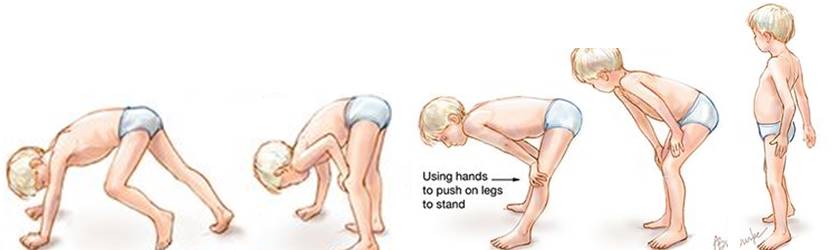
A positive Gowers' sign reflects proximal lower limb weakness. The child uses their upper limbs to rise: first pushing up onto hands and knees, then “walking” their hands up their thighs to stand. This is classic for Duchenne Muscular Dystrophy (DMD).
📖 About
- 💀 Lethal X-linked recessive disorder, belonging to the muscular dystrophies.
- 🧬 These conditions cause progressive muscle weakness and loss of muscle mass due to absent or defective dystrophin protein.
🧬 Aetiology
- X-linked recessive inheritance – mutation in the DMD gene on Xp21.
- Female carriers may show mild muscle fatigue and are at increased risk of cardiomyopathy.
🩺 Clinical Features
- 👦 Onset age 3–6 years: progressive weakness of proximal limb-girdle muscles.
- ❤️ Cardiac involvement is almost universal.
- 🐂 Calf pseudohypertrophy due to fat and connective tissue replacement.
- 🚶♂️ Progressive difficulty walking; wheelchair use by early adolescence.
- 🫁 Death typically by age 30 from respiratory failure or cardiomyopathy.
- 🦴 Contractures, scoliosis, intellectual impairment, and reduced night vision may also develop.
🔍 Differentials
- Other muscular dystrophies (e.g. Becker MD, Limb-girdle MD)
- Cerebral palsy
🧪 Investigations
- 📈 Serum CK-MM markedly elevated (often >10,000 IU/L).
- 🧬 Genetic testing: exon deletion/duplication in ~65% cases.
- 💉 Muscle biopsy & EMG (show muscle fibre necrosis and myopathic changes).
- 🫀 ECG, CXR & Echocardiogram for cardiomyopathy assessment.
💊 Management
- Supportive and multidisciplinary care is key.
- 💊 Corticosteroids (prednisolone/deflazacort) may slow progression.
- 🧾 Genetic counselling: sons of affected men are unaffected, but all daughters are obligate carriers.
- 🏊♂️ Exercise such as swimming can preserve function.
- 🦽 Good OT/PT input → wheelchairs, home adaptations, splints.
- 🫁 Respiratory support (NIV, cough assist devices) as disease advances.
📚 References
- Royal College of Paediatrics and Child Health – Neuromuscular Disorders guidance.
- BNF for Children, NICE Clinical Knowledge Summaries.
- Emery AE. Duchenne Muscular Dystrophy. Oxford University Press.
🧾 Clinical Case – Duchenne Muscular Dystrophy
A 6-year-old boy is brought to clinic with progressive difficulty climbing stairs and frequent falls.
On examination, he has proximal lower limb weakness, enlarged calves (pseudohypertrophy), and uses the Gowers’ manoeuvre to rise from the floor.
Family history reveals a maternal uncle with similar symptoms.
Creatine kinase is markedly elevated, and genetic testing confirms a dystrophin gene mutation.
👉 Diagnosis: Duchenne muscular dystrophy.
👉 Management: physiotherapy, corticosteroids, cardiac/respiratory monitoring, and genetic counselling.
