
| Download the amazing global Makindo app: ✅ Means NICE/National Guidelines 2026 compliant Android | Apple | |
|---|---|
| MEDICAL DISCLAIMER: Educational use only. Not for diagnosis or management. See below for full disclaimer. |
DNA and RNA
Related Subjects: |DNA and RNA short notes |DNA replication |DNA structure in Nucleus |Mitosis and Meiosis |Telomeres |Autosomal Recessive |X Linked Recessive |Autosomal Dominant |Li Fraumeni syndrome |Genetic Linkage |Cell Cycle
Chargaff's rules: In double-stranded DNA ➡️ %A = %T and %G = %C. Purines = Pyrimidines overall. These base-pairing rules were known before Watson & Crick’s helix model.
🧱 Building Blocks
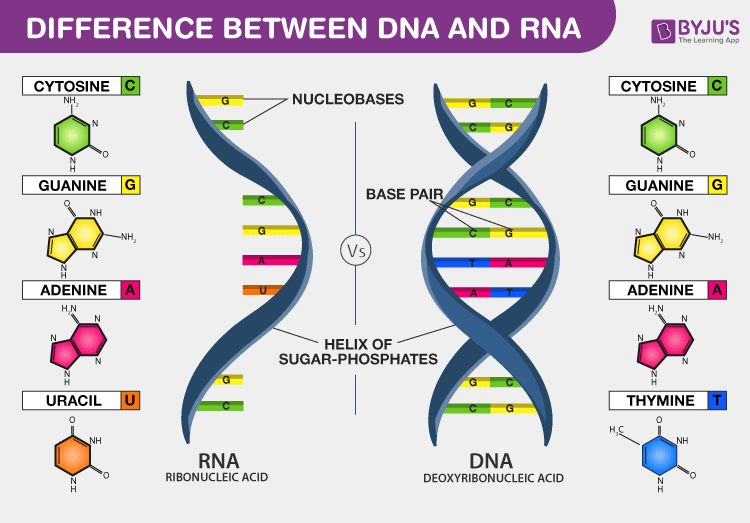
- Purines (2 rings): Adenine (A), Guanine (G). Synthesis requires glycine, aspartate, glutamine.
- Pyrimidines (1 ring): Cytosine (C), Thymine (T in DNA), Uracil (U in RNA).
- Base pairing → Purine + Pyrimidine (3 rings across) maintains uniform helix width.
📜 Nucleic Acids
- DNA: A=T (2 H-bonds), G≡C (3 H-bonds - stronger!).
- RNA: A=U, G≡C. Usually single-stranded.
- Sugars: DNA = deoxyribose; RNA = ribose (extra OH → less stable).
- Human diploid genome = 23 chromosome pairs.
- DNA → nuclear; RNA → 90% cytoplasmic.
🔬 Types of RNA
- mRNA: Protein template. 5′ cap + 3′ poly(A) tail = stability & translation.
- tRNA: Cloverleaf adaptor carrying amino acids (anticodon matches codon).
- rRNA: Structural + catalytic core of ribosomes (peptidyl transferase activity).
📆 Eukaryotic Cell Cycle
- G0: Resting phase (neurons, RBCs stay here permanently).
- G1: Growth, organelle duplication. Restriction point checks DNA damage.
- S: DNA replication. Centrosome duplication.
- G2: Error checking before mitosis.
- M: Mitosis (prophase → telophase + cytokinesis).
⚡ DNA Replication
- Semiconservative: 1 parental + 1 new strand.
- DNA polymerase: works 5′→3′; needs an RNA primer.
- Leading strand: continuous synthesis.
- Lagging strand: Okazaki fragments (later ligated).
- Error rate: ~1 per 10¹⁰ bases (proofreading via 3′→5′ exonuclease).
- mtDNA: circular, maternal inheritance.
- Proto-oncogenes regulate cycle; mutations → oncogenes → cancer.
🔄 Quality Control
- Checkpoints (cyclins + CDKs regulate):
- G1/S: “restriction point” – damaged DNA? nutrients sufficient?
- G2/M: DNA replicated? errors fixed?
- Metaphase checkpoint: spindle attachment?
⏳ Telomeres
- Repeat sequences (TTAGGG in humans) protect chromosome ends.
- Shorten with each division → cellular aging (“replicative senescence”).
- Germline, stem, and cancer cells express telomerase → immortality.
⚡ Energy for Replication
- Energy comes from hydrolysis of nucleoside triphosphates → pyrophosphate release drives chain elongation.
- Strand growth always at the 3′ end.
- Diagram: Okazaki fragments

📌 Quick Exam Summary
🧬 A=T (2 bonds), G≡C (3 bonds). 📆 Cell cycle checkpoints stop faulty replication. ⚡ Replication is semiconservative, 5′→3′, with leading vs lagging strands. ⏳ Telomeres shorten with age unless telomerase is active. 💥 Oncogenes = mutated proto-oncogenes → unchecked growth.
| The content on this website is provided for educational and informational purposes only to support exam preparation (e.g., MLA, MRCP, USMLE) and learning. This is NOT medical advice, diagnosis, treatment, or professional guidance. It does not replace consultation with a qualified healthcare professional, official guidelines (e.g., NICE, GMC, BNF), or supervised clinical practice. Always verify information with current, authoritative sources. Makindo and its contributors accept no liability for any reliance on this content, including errors, omissions, or any resulting harm, loss, or consequences. By using this site, you agree to these terms. |
|
|
Categories
- About
- Acute Medicine
- Anaesthetics and Critical Care
- Anatomy
- Anatomy and Physiology
- Biochemistry
- Book
- Cardiology
- Collections
- CompSci
- Crib Sheets
- Critical care
- Dental
- Dermatology
- Differentials
- Drugs
- ENT
- Electrocardiogram
- Embryology
- Emergency Medicine
- Endocrinology
- Ethics
- Foundation Doctors
- GCSE
- Gastroenterology
- General Practice
- Genetics
- Geriatric Medicine
- Geriatrics
- Guidelines
- Haematology
- Hepatology
- Immunology
- Infectious Diseases
- Infographic
- Investigations
- Lists
- MRCP
- Mandatory Training
- Medical Students
- Microbiology
- Nephrology
- Neurology
- Neurosurgery
- Nutrition
- OSCE
- Obstetrics Gynaecology
- Oncology
- Ophthalmology
- Oral Medicine and Dentistry
- Orthopaedics
- Paediatrics
- Palliative
- Palliative Care
- Pathology
- Pharmacology
- Physiology
- Procedures
- Psychiatry
- Public Health
- Radiology
- Respiratory
- Resuscitation
- Revision Topics
- Rheumatology
- Statistics and Research
- Stroke
- Surgery
- Toxicology
- Trauma and Orthopaedics
- USMLE
- Urology
- Vascular Surgery