Related Subjects:
|Brain tumour s
|Astrocytomas
|Brain Metastases
|Tuberous sclerosis
|Turcot's syndrome
|Lhermitte Duclos Disease
|Oligodendroglioma
|Acute Hydrocephalus
|Intracranial Hypertension
|Primary CNS Lymphoma (PCNSL)
🧠 Lhermitte-Duclos disease (LDD) is the most common type of brain lesion in adult patients with Cowden syndrome.
It is a very rare, benign, slow-growing cerebellar tumour, classically a dysplastic gangliocytoma.
⚠️ Its recognition is important because of its association with PTEN mutations and hereditary cancer risk.
ℹ️ About
- Rare, benign posterior fossa tumour of the cerebellum.
- Histology: Dysplastic gangliocytoma with abnormal large ganglion cells.
- Associated with Cowden syndrome (PTEN hamartoma tumour syndrome).
🧬 Aetiology & Pathogenesis
- Due to abnormal development and hypertrophy of cerebellar granule cells and folia.
- Genetic driver: PTEN tumour suppressor gene mutations (10q23.3). 🧬
- Can cause raised intracranial pressure via obstructive hydrocephalus.
👩⚕️ Clinical Features
- Typically presents between ages 10–30; ♂ = ♀.
- Symptoms: Progressive headache, nausea/vomiting, cerebellar ataxia, gait disturbance, diplopia, hydrocephalus.
- Associated findings:
• Megalencephaly 🧠
• Hydromyelia
• Polydactyly 🖐️
• Macroglossia 👅
• Partial gigantism
- Important OSCE clue: Look for neurological symptoms in a patient with Cowden features (thyroid, breast, skin lesions).
🔎 Investigations
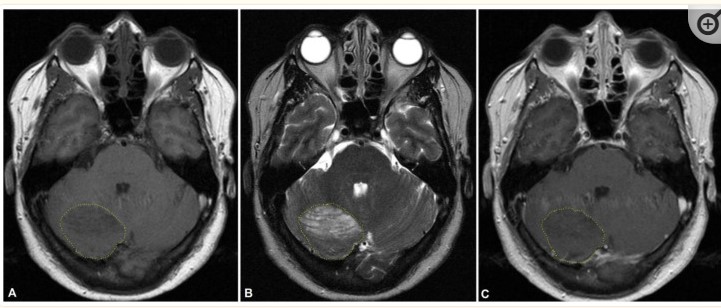
- MRI (gold standard):
• Non-enhancing cerebellar lesion
• Thickened cerebellar folia with “tiger stripe” striated pattern 🐅
• Hypointense on T1, hyperintense on T2
• No contrast enhancement
- Helps distinguish from other posterior fossa tumours (e.g. medulloblastoma, astrocytoma).
🧫 Pathology
- Dysplastic gangliocytoma: Large, abnormal ganglion cells replacing granule cells of the cerebellum.
- No malignant transformation risk in the lesion itself, but systemic cancer risk due to Cowden syndrome is high. 🎯
💊 Management
- Asymptomatic cases: Conservative monitoring, as the tumour is benign and slow-growing.
- Symptomatic cases: Neurosurgical resection to relieve mass effect or hydrocephalus.
- Complete resection: Often challenging due to diffuse cerebellar involvement, but attempted if severe oedema or progressive symptoms.
- Follow-up: Regular surveillance for Cowden-associated malignancies (breast, thyroid, endometrium, GI tract).
📚 References
