Brighton Mobility Score
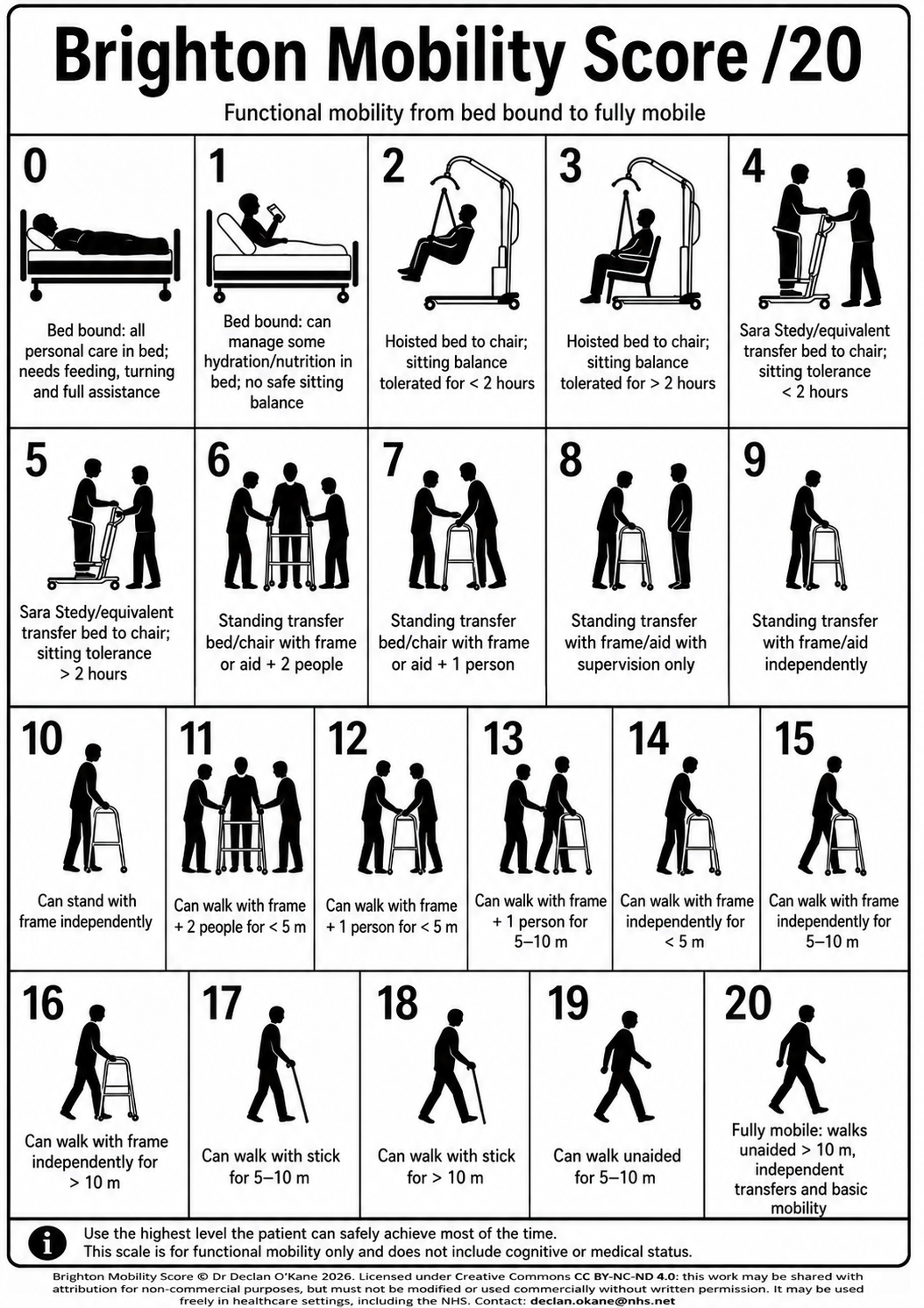
🧍♂️🛏️ The Brighton Mobility Score is a practical bedside mobility scale used to describe a patient’s current level of mobility, transfer ability and walking function.
It ranges from patients who are fully bed bound and dependent for care, through those needing hoisting or standing-transfer aids, to patients who can walk independently with a frame or stick.
ℹ️ About
- 🛏️ The score starts with patients who are fully bed bound and require full assistance with personal care.
- 🪑 It then progresses through sitting balance, hoisted transfers and assisted bed-to-chair transfers.
- 🚶 It includes standing transfers, walking with a frame, and walking with one or two people assisting.
- ✅ The aim is to describe what the patient can actually do now, not their usual baseline or hoped-for discharge mobility.
🎯 Why It Is Useful
- 👩⚕️ Helps nursing, medical and therapy teams communicate mobility clearly.
- 🗣️ Useful during ward rounds, board rounds, handovers and discharge planning.
- 📋 Provides clearer descriptions than vague phrases such as “poor mobility” or “reduced mobility”.
- 🏠 Supports planning for equipment, care packages, rehabilitation and safe discharge.
🧠 Clinical Importance
- ⚖️ Mobility is an important marker of frailty, functional reserve and recovery potential.
- 📉 Reduced mobility increases the risk of deconditioning and loss of independence.
- 🛏️ Immobility increases the risk of pressure damage, falls, venous thromboembolism and hospital-acquired infection.
- ⏳ Tracking mobility over time can show improvement, deterioration or failure to progress.
- 🚩 A sudden drop in mobility should prompt review for pain, delirium, infection, medication effects, hypotension, stroke or other acute illness.
🧾 Example Descriptions
- 🛏️ “Bed bound and dependent for all personal care.”
- 🪑 “Hoisted bed to chair, sitting balance less than 2 hours.”
- 🧍 “Standing transfer with frame and two people.”
- 🚶 “Walks 5–10 metres with a frame and one person.”
- ✅ “Walks independently with a frame.”
🛠️ How to Use
- 👀 Score the patient based on their observed current mobility.
- 🔁 Reassess after illness, falls, surgery, rehabilitation or clinical deterioration.
- 📈 Use change in score to track progress or decline over time.
- 👥 Discuss with physiotherapy and occupational therapy if the patient’s score affects discharge planning.
- 🏠 Consider the patient’s home environment, stairs, carers, equipment and baseline function.
⚠️ Important Limitations
- 🩺 The Brighton Mobility Score is a clinical communication aid, not a replacement for professional assessment.
- 🧠 Interpret alongside cognition, delirium risk, balance, pain, cardiovascular stability and falls risk.
- 💊 Medication, postural hypotension, sedation and acute illness may all affect mobility.
- 🎯 Always consider the patient’s own rehabilitation goals and usual baseline function.
📌 Key Points
- 💡 The score describes current functional mobility.
- 💡 It helps teams avoid unclear terms such as “poor mobility”.
- 💡 It can support rehabilitation planning, discharge decisions and care needs assessment.
- 💡 A falling mobility score may be an early sign of clinical deterioration.
- 💡 Use alongside clinical judgement, therapy assessment and patient goals.
Brighton Mobility Score © Dr Declan O’Kane 2026.
This work is licensed under CC BY-NC-ND 4.0: it may be shared with attribution for non-commercial purposes,
but must not be modified or used commercially without written permission.
Contact: declan.okane@nhs.net
