Related Subjects:
|Nikolsky's sign
|Koebner phenomenon
|Erythema Multiforme
|Pyoderma gangrenosum
|Erythema Nodosum
|Dermatitis Herpetiformis
|Lichen Planus
|Acanthosis Nigricans
|Acne Rosacea
|Acne Vulgaris
|Alopecia
|Vitiligo
|Urticaria
|Basal Cell Carcinoma
|Malignant Melanoma
|Squamous Cell Carcinoma
|Mycosis Fungoides (Sezary Syndrome)
|Xeroderma pigmentosum
|Bullous Pemphigoid
|Pemphigus Vulgaris
|Seborrheic Dermatitis
|Pityriasis/Tinea versicolor infections
|Pityriasis rosea
|Scabies
|Dermatomyositis
|Toxic Epidermal Necrolysis
|Stevens-Johnson Syndrome
|Atopic Eczema/Atopic Dermatitis
|Psoriasis
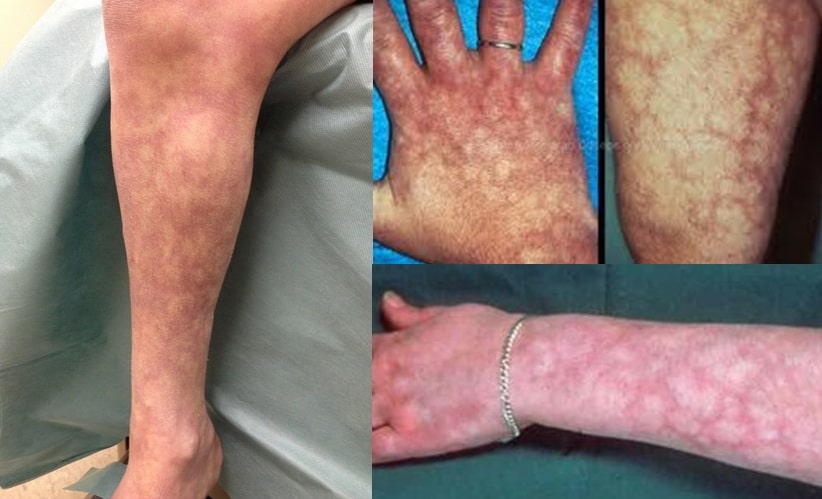
🌐 Livedo reticularis is caused by dilatation and stagnation of blood within dermal capillaries and venules, producing a mottled, net-like discoloration of the skin.
📖 About
- Livedo reticularis is a cutaneous vascular pattern characterised by a mottled, reticular (net-like) violaceous discoloration of the skin.
- It may be physiological (benign) or associated with vascular, autoimmune, or thrombotic disease.
- Physiological forms are often triggered by cold exposure and resolve with warming.
- Pathological forms may persist and are sometimes referred to as livedo racemosa.
🩺 Clinical Features
- Mottled blue-red or violaceous reticular pattern on the skin.
- Most commonly affects the legs, thighs, arms, and trunk.
- Physiological livedo typically worsens in cold environments ❄️ and improves with warming.
- Persistent or irregular livedo may indicate underlying vascular or autoimmune disease.
- Associated systemic symptoms may include headache, dizziness, or neurological deficits, particularly in disorders such as Sneddon syndrome.
🧾 Causes
- Physiological: Cold-induced cutis marmorata (common and benign).
- Autoimmune/connective tissue disease: systemic lupus erythematosus, rheumatoid arthritis, dermatomyositis.
- Vasculopathy or vasculitis: polyarteritis nodosa, antiphospholipid syndrome.
- Haematological or thrombotic disorders: hypercoagulable states, cryoglobulinaemia.
- Infective associations: hepatitis C (particularly with cryoglobulinaemia).
- Embolic disease: cholesterol embolisation following vascular procedures.
- Inherited/metabolic: homocystinuria.
- Sneddon syndrome: persistent livedo with cerebrovascular disease and increased stroke risk 🚨.
🔬 Investigations
- Blood tests: FBC, U&E, inflammatory markers, autoimmune screen (ANA, dsDNA), rheumatoid factor.
- Coagulation tests: antiphospholipid antibodies and clotting profile if thrombophilia suspected.
- Infection screening: hepatitis C serology where clinically appropriate.
- Further testing: vascular imaging or biopsy if vasculitis or embolic disease suspected.
💊 Management
- Identify and treat the underlying cause where present.
- Conservative measures: keep warm and avoid vasoconstrictive triggers such as smoking or sympathomimetic drugs.
- Autoimmune disease: immunosuppressive therapy may be required.
- Thrombotic disorders: anticoagulation may be indicated.
- Infective causes: treat underlying infection (e.g., antiviral therapy for hepatitis C).
🧠 Exam Tip
- Antiphospholipid syndrome and Sneddon syndrome are classic associations → think “livedo + stroke risk.”
📚 Guideline & Reference Sources