
| Download the amazing global Makindo app: ✅ Means NICE/National Guidelines 2026 compliant Android | Apple | |
|---|---|
| MEDICAL DISCLAIMER: Educational use only. Not for diagnosis or management. See below for full disclaimer. |
Thalamus
Related Subjects: |Medulla Oblongata |Midbrain |Pons |Caudate Nucleus |Putamen and Globus Pallidus |Cerebral Cortex |Internal Capsule |Cavernous sinus |Basal Ganglia |Brainstem Anatomy |Thalamic Anatomy |Caudate Nucleus
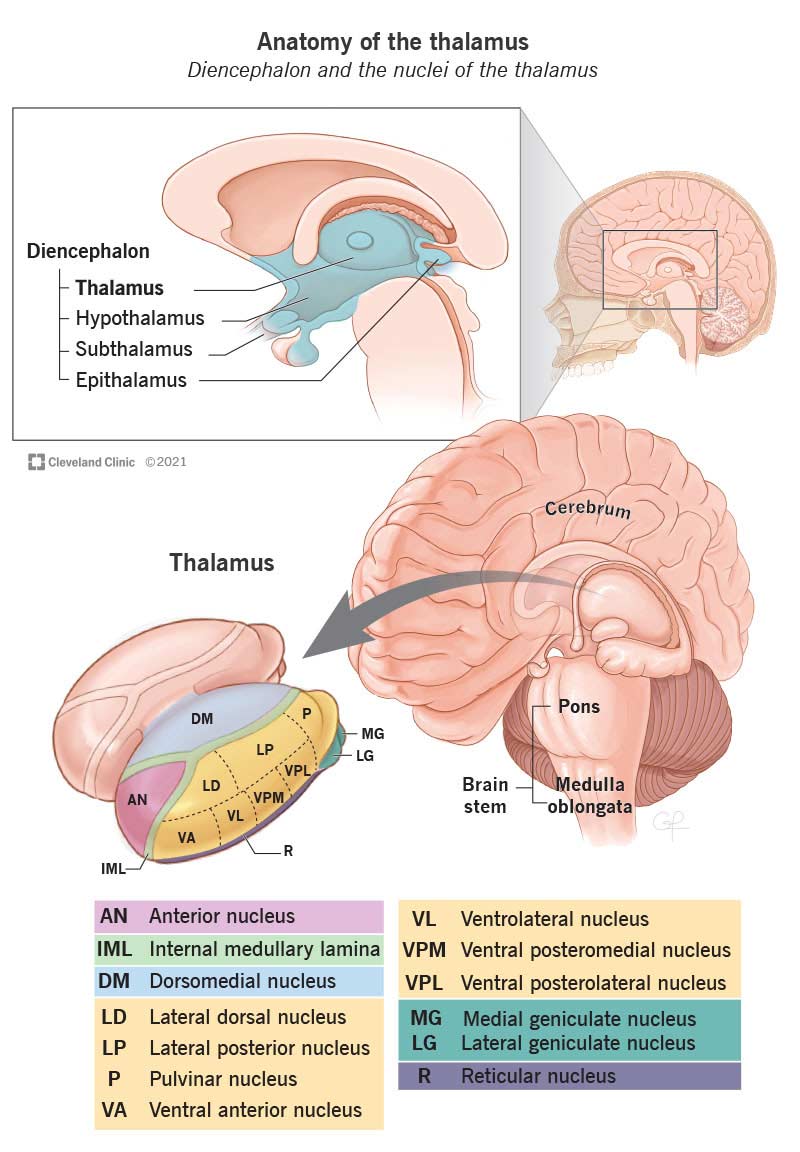
- 📍 Location: The thalamus lies in the diencephalon, above the brainstem and between the cerebral cortex and midbrain. It sits on either side of the third ventricle.
- 🏗️ Structure:
- Paired structure ➝ right and left thalami, one in each hemisphere.
- Made of multiple nuclei grouped as:
- Anterior group
- Medial group
- Lateral group (dorsal & ventral tiers)
- Intralaminar group
- Midline group
- Reticular nucleus
- ⚙️ Functions:
- Sensory relay: All sensory input (except smell) passes through thalamus to cortex.
- Motor integration: Links basal ganglia ↔ motor cortex.
- Consciousness & alertness: Regulates sleep–wake cycles and awareness.
- Memory & emotion: Limbic system connections influence affect and recall.
- 🩸 Blood Supply:
- Posterior cerebral artery (PCA): Main source.
- Thalamogeniculate arteries: Supply lateral geniculate body and lateral thalamus.
- Thalamoperforating arteries: Supply anterior thalamus.
- 🚨 Clinical Significance:
- Thalamic stroke: Sensory loss, motor weakness, cognitive/emotional changes.
- Thalamic pain syndrome (Dejerine–Roussy): Chronic post-stroke pain.
- Neurodegeneration: Thalamus affected in Parkinson’s, MS, and others ➝ varied neurological symptoms.
| The content on this website is provided for educational and informational purposes only to support exam preparation (e.g., MLA, MRCP, USMLE) and learning. This is NOT medical advice, diagnosis, treatment, or professional guidance. It does not replace consultation with a qualified healthcare professional, official guidelines (e.g., NICE, GMC, BNF), or supervised clinical practice. Always verify information with current, authoritative sources. Makindo and its contributors accept no liability for any reliance on this content, including errors, omissions, or any resulting harm, loss, or consequences. By using this site, you agree to these terms. |
|
|
Categories
- About
- Acute Medicine
- Anaesthetics and Critical Care
- Anatomy
- Anatomy and Physiology
- Biochemistry
- Book
- Cardiology
- Collections
- CompSci
- Crib Sheets
- Critical care
- Dental
- Dermatology
- Differentials
- Drugs
- ENT
- Electrocardiogram
- Embryology
- Emergency Medicine
- Endocrinology
- Ethics
- Foundation Doctors
- GCSE
- Gastroenterology
- General Practice
- Genetics
- Geriatric Medicine
- Geriatrics
- Guidelines
- Haematology
- Hepatology
- Immunology
- Infectious Diseases
- Infographic
- Investigations
- Lists
- MRCP
- Mandatory Training
- Medical Students
- Microbiology
- Nephrology
- Neurology
- Neurosurgery
- Nutrition
- OSCE
- Obstetrics Gynaecology
- Oncology
- Ophthalmology
- Oral Medicine and Dentistry
- Orthopaedics
- Paediatrics
- Palliative
- Palliative Care
- Pathology
- Pharmacology
- Physiology
- Procedures
- Psychiatry
- Public Health
- Radiology
- Respiratory
- Resuscitation
- Revision Topics
- Rheumatology
- Statistics and Research
- Stroke
- Surgery
- Toxicology
- Trauma and Orthopaedics
- USMLE
- Urology
- Vascular Surgery