
| Download the amazing global Makindo app: ✅ Means NICE/National Guidelines 2026 compliant Android | Apple | |
|---|---|
| MEDICAL DISCLAIMER: Educational use only. Not for diagnosis or management. See below for full disclaimer. |
Protein Synthesis
Related Subjects: |Protein metabolism |Protein Synthesis |Amino acids |Human Metabolism |Carbohydrates |Hydrogen and other Bonds
🧬 Messenger RNA (mRNA) carries genetic information from DNA → ribosomes, where it acts as a template for protein synthesis. It is produced through transcription, processed, and then exported to the cytoplasm for translation.
🪜 Steps of mRNA Production
- Transcription 📝 :
- Initiation 🚦: Transcription factors + RNA polymerase II bind to promoter → DNA unwinds → RNA synthesis starts.
- Elongation ➡️: RNA polymerase II moves along DNA, adding nucleotides 5' → 3'.
- Termination 🛑: RNA polymerase encounters termination signal → transcript released.
- RNA Processing ⚙️ :
- 5' Capping 🎩: 7-methylguanosine cap protects mRNA + aids ribosome binding.
- Splicing ✂️: Introns removed, exons joined (spliceosome-mediated). ➡️ Allows alternative splicing → multiple proteins from one gene.
- 3' Polyadenylation 🧵: Poly-A tail stabilises transcript + aids nuclear export.
- Export 🚪 :
- Mature mRNA passes through nuclear pores → cytoplasm → ribosomes.
🎚️ Regulation of mRNA
- Transcriptional 📝: Controlled by enhancers, silencers, transcription factors.
- Processing ⚡: Alternative splicing + RNA-binding proteins regulate diversity.
- Stability ⏳: 5' UTR, 3' UTR and miRNAs influence degradation vs protection.
💊 Clinical Relevance of mRNA
- Genetic Disorders 🧩: Abnormal splicing → thalassaemias; dysregulated transcription → cancers.
- Therapeutics 💉:
- mRNA vaccines (e.g. COVID-19) = synthetic mRNA encodes viral proteins → immune response.
- Gene therapy: Functional mRNA delivery to bypass defective genes.
📌 Key exam tip: mRNA always has 5' cap + poly-A tail. If either is missing → unstable transcript or failed translation.
📖 Overview of Protein Synthesis
Protein synthesis = DNA → mRNA (transcription) → protein (translation). It requires mRNA, tRNA, ribosomes, and amino acids.
🔬 Stages of Protein Synthesis
- Transcription (nucleus) – as above: initiation, elongation, termination → pre-mRNA → processed mRNA.
- Translation (cytoplasm) :
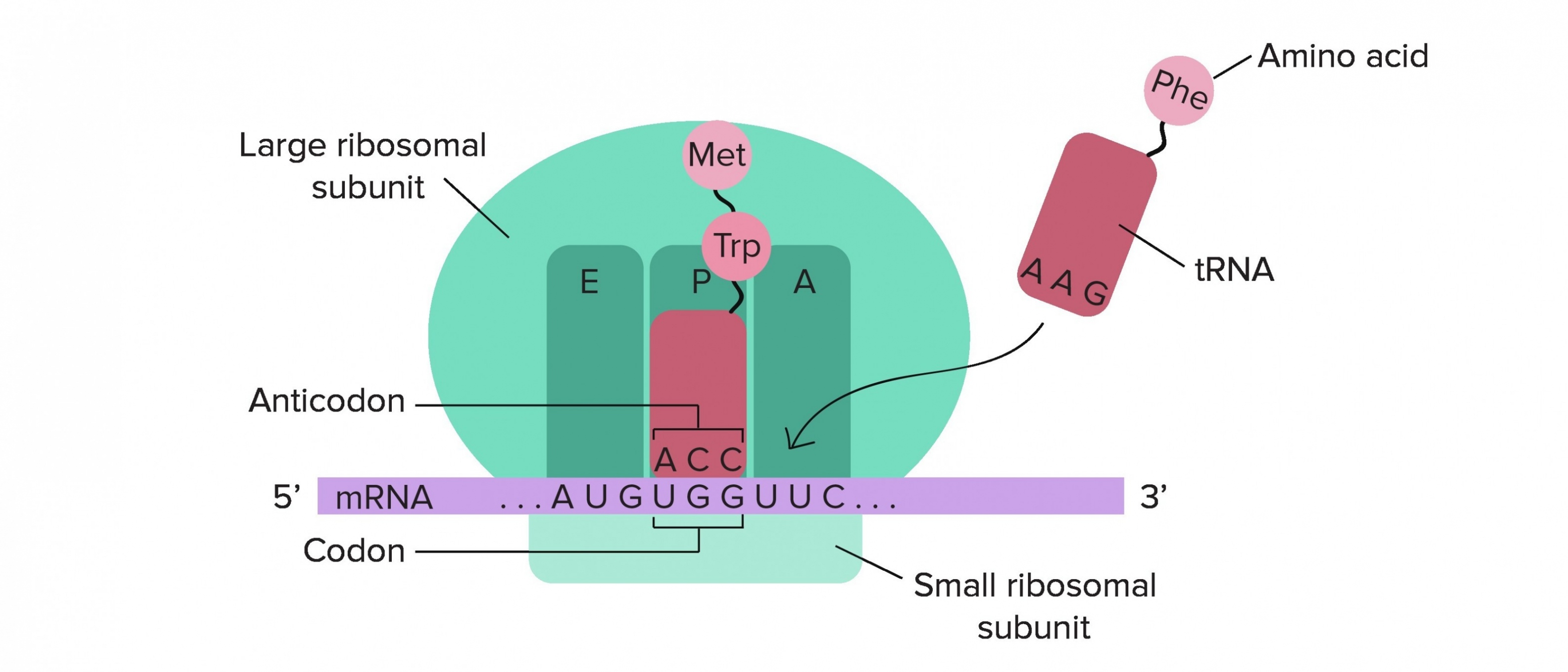
- Initiation 🚀: Ribosome binds 5' cap, finds AUG (start codon), initiator tRNA (Met) joins at P site.
- Elongation ➡️: Aminoacyl-tRNAs deliver amino acids, peptide bonds form, ribosome translocates along mRNA.
- Termination 🛑: Stop codon reached (UAA, UAG, UGA) → release factors free polypeptide.
🧩 Key Components
- mRNA 🧬: Genetic template.
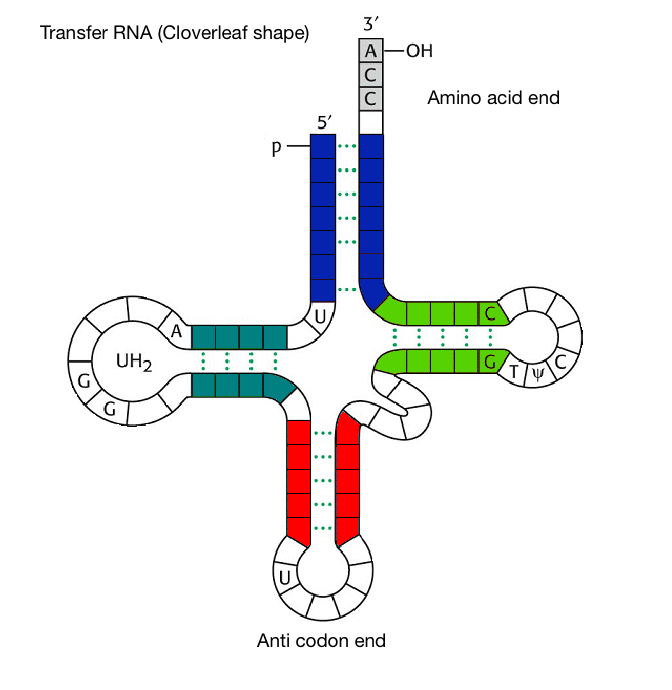
- tRNA 🎯: Transfers amino acids; anticodon matches codon.
- Ribosome ⚙️: Protein factory (large + small subunits).
- Amino acids 🍽️: Building blocks joined by peptide bonds.
🎚️ Regulation
- Transcriptional: Control of which genes are switched on/off.
- Translational: Initiation factors, uORFs, microRNAs.
- Post-translational: Modifications (phosphorylation, glycosylation, ubiquitination) → alter function.
⚠️ Clinical Relevance
- Genetic disorders 🧩: e.g. cystic fibrosis, sickle cell anaemia.
- Antibiotics 💊: Tetracyclines, macrolides, aminoglycosides → inhibit bacterial ribosomes.
- Targeted therapies 🎯: Cancer drugs exploit abnormal protein synthesis regulation.
📝 Summary
Protein synthesis is essential for life. Errors → disease; regulation → therapeutic target. Key to understand: DNA transcription → RNA processing → mRNA export → translation into protein 🧬➡️💪.
📷 Diagrams
🧾 Example: DNA → Protein
| Molecule | Code |
|---|---|
| DNA | CTA ATA TAA CCC |
| mRNA | GAU UAU AUU GGG |
| Protein | Asp – Tyr – Ile – Gly |
| The content on this website is provided for educational and informational purposes only to support exam preparation (e.g., MLA, MRCP, USMLE) and learning. This is NOT medical advice, diagnosis, treatment, or professional guidance. It does not replace consultation with a qualified healthcare professional, official guidelines (e.g., NICE, GMC, BNF), or supervised clinical practice. Always verify information with current, authoritative sources. Makindo and its contributors accept no liability for any reliance on this content, including errors, omissions, or any resulting harm, loss, or consequences. By using this site, you agree to these terms. |
|
|
Categories
- About
- Acute Medicine
- Anaesthetics and Critical Care
- Anatomy
- Anatomy and Physiology
- Biochemistry
- Book
- Cardiology
- Collections
- CompSci
- Crib Sheets
- Critical care
- Dental
- Dermatology
- Differentials
- Drugs
- ENT
- Electrocardiogram
- Embryology
- Emergency Medicine
- Endocrinology
- Ethics
- Foundation Doctors
- GCSE
- Gastroenterology
- General Practice
- Genetics
- Geriatric Medicine
- Geriatrics
- Guidelines
- Haematology
- Hepatology
- Immunology
- Infectious Diseases
- Infographic
- Investigations
- Lists
- MRCP
- Mandatory Training
- Medical Students
- Microbiology
- Nephrology
- Neurology
- Neurosurgery
- Nutrition
- OSCE
- Obstetrics Gynaecology
- Oncology
- Ophthalmology
- Oral Medicine and Dentistry
- Orthopaedics
- Paediatrics
- Palliative
- Palliative Care
- Pathology
- Pharmacology
- Physiology
- Procedures
- Psychiatry
- Public Health
- Radiology
- Respiratory
- Resuscitation
- Revision Topics
- Rheumatology
- Statistics and Research
- Stroke
- Surgery
- Toxicology
- Trauma and Orthopaedics
- USMLE
- Urology
- Vascular Surgery