
| Download the amazing global Makindo app: ✅ Means NICE/National Guidelines 2026 compliant Android | Apple | |
|---|---|
| MEDICAL DISCLAIMER: Educational use only. Not for diagnosis or management. See below for full disclaimer. |
Hydrogen and other Bonds
Related Subjects: |Carbohydrates |Hydrogen and other Bonds
🌍 Life depends on chemistry: every heartbeat, thought, and breath reflects countless atoms of oxygen, carbon, hydrogen, and other elements forming and breaking bonds. ⚡ These dynamic interactions create the structure of biomolecules and drive metabolism, energy transfer, and signalling.
🔗 Types of Chemical Bonds
- ⚡ Ionic Bonds:
Ions are charged atoms formed when one atom donates or accepts electrons.
- Positive = cation (e.g., Na⁺)
- Negative = anion (e.g., Cl⁻)
- Opposite charges attract → form ionic bonds (e.g., NaCl crystals).
- Biological relevance: Key in nerve conduction, muscle contraction, and electrolyte balance.
- 🔗 Covalent Bonds:
Electrons are shared between atoms.
- Nonpolar covalent bonds: Equal sharing of electrons → electrically neutral molecules (e.g., O₂, CH₄). 🧪 Basis of lipid membranes (hydrophobic tails).
- Polar covalent bonds: Unequal sharing → “poles” of charge (e.g., H₂O). 💧 This underlies solubility and hydrogen bonding.
- Biological relevance: Stable backbone of DNA, proteins, carbohydrates.
- 💧 Hydrogen Bonds:
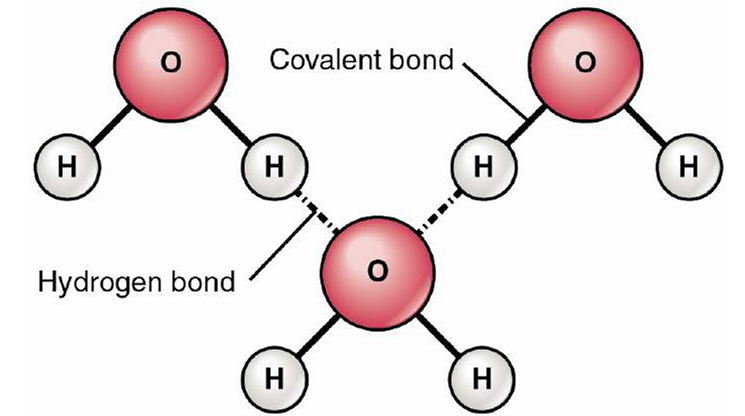
A weak but vital interaction when a hydrogen atom covalently bound to an electronegative atom (O, N) is attracted to another electronegative atom.
- Weaker than covalent/ionic bonds but crucial for life.
- Stabilises DNA double helix, protein secondary structures (α-helix, β-sheet).
- Gives water its unique properties: high boiling point, surface tension, excellent solvent.
🧬 Integration in Biology
In living organisms, bonds constantly form and break to allow flexibility and energy flow:
- 💧 Water: Polar covalent bonds → hydrogen bonding → solvent of life.
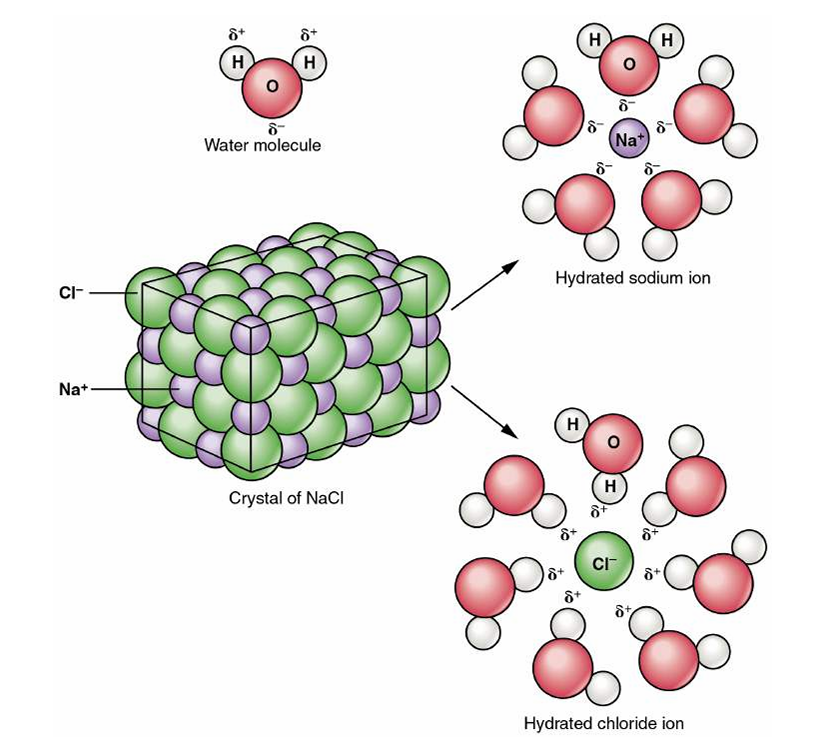
- 🧂 Ionic interactions: Salt (NaCl) dissolves via ion-dipole interactions with water.
- 🥑 Nonpolar covalent bonds: Hydrophobic lipids cluster in membranes → essential for cell structure.
- 🧩 Proteins: Hydrogen bonds + ionic interactions stabilise folding and enzyme function.
📊 Clinical & Physiological Relevance
- ⚡ Electrolyte imbalance: Low Na⁺, K⁺, or Ca²⁺ disrupt ionic gradients → arrhythmias, seizures.
- 🧬 DNA damage: Breaking hydrogen bonds → mutation or apoptosis.
- 🌡️ Fever: Alters hydrogen bonding in proteins → denaturation at high temperatures.
🧂 Dissociation of Sodium Chloride in Water
NaCl does not dissolve as intact molecules but dissociates into Na⁺ cations and Cl⁻ anions, each surrounded by water molecules (hydration shells) → stabilising ions in solution. 🔑 This principle explains conduction in nerves and osmotic gradients.
✅ Conclusion
From ionic Na⁺/Cl⁻ gradients powering nerve impulses, to hydrogen bonds shaping DNA and proteins, chemical bonds are the language of biology. 🔑 Understanding these interactions helps explain everything from cell signalling and drug action to genetic inheritance and disease.
| The content on this website is provided for educational and informational purposes only to support exam preparation (e.g., MLA, MRCP, USMLE) and learning. This is NOT medical advice, diagnosis, treatment, or professional guidance. It does not replace consultation with a qualified healthcare professional, official guidelines (e.g., NICE, GMC, BNF), or supervised clinical practice. Always verify information with current, authoritative sources. Makindo and its contributors accept no liability for any reliance on this content, including errors, omissions, or any resulting harm, loss, or consequences. By using this site, you agree to these terms. |
|
|
Categories
- About
- Acute Medicine
- Anaesthetics and Critical Care
- Anatomy
- Anatomy and Physiology
- Biochemistry
- Book
- Cardiology
- Collections
- CompSci
- Crib Sheets
- Critical care
- Dental
- Dermatology
- Differentials
- Drugs
- ENT
- Electrocardiogram
- Embryology
- Emergency Medicine
- Endocrinology
- Ethics
- Foundation Doctors
- GCSE
- Gastroenterology
- General Practice
- Genetics
- Geriatric Medicine
- Geriatrics
- Guidelines
- Haematology
- Hepatology
- Immunology
- Infectious Diseases
- Infographic
- Investigations
- Lists
- MRCP
- Mandatory Training
- Medical Students
- Microbiology
- Nephrology
- Neurology
- Neurosurgery
- Nutrition
- OSCE
- Obstetrics Gynaecology
- Oncology
- Ophthalmology
- Oral Medicine and Dentistry
- Orthopaedics
- Paediatrics
- Palliative
- Palliative Care
- Pathology
- Pharmacology
- Physiology
- Procedures
- Psychiatry
- Public Health
- Radiology
- Respiratory
- Resuscitation
- Revision Topics
- Rheumatology
- Statistics and Research
- Stroke
- Surgery
- Toxicology
- Trauma and Orthopaedics
- USMLE
- Urology
- Vascular Surgery