
| Download the amazing global Makindo app: ✅ Means NICE/National Guidelines 2026 compliant Android | Apple | |
|---|---|
| MEDICAL DISCLAIMER: Educational use only. Not for diagnosis or management. See below for full disclaimer. |
Malignant pleural mesothelioma
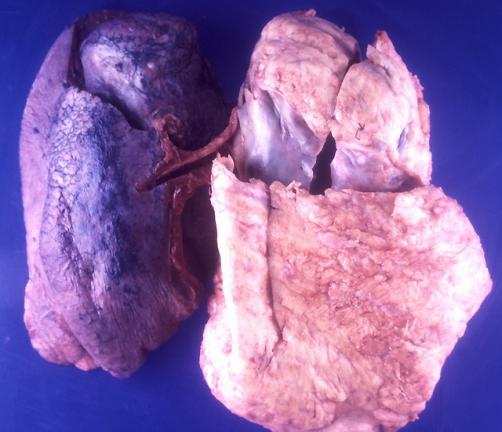
🫁 Mesothelioma encasing the lung - classically a malignant pleural tumour strongly linked to asbestos exposure.
📖 About
- 🔬 Malignant pleural mesothelioma (MPM) is a rare but aggressive tumour of the pleura.
- 🧱 Strongly associated with asbestos exposure (occupational in 70–80%).
- ⚠️ Long latency (20–50 years) between exposure and disease.
- 🚬 Smoking increases risk when combined with asbestos.
⚙️ Aetiology
- ☣️ Direct or indirect exposure to asbestos dust (shipbuilding, insulation, construction).
- 🏭 High-risk industries: shipyard workers, construction, asbestos miners.
- Family members may be exposed indirectly (dust on work clothes).
🧑⚕️ Clinical Features
- 🫁 Thoracic: chest pain, pleuritic pain, dyspnoea, cough, weight loss, recurrent pleural effusions.
- 📉 Abdominal (peritoneal mesothelioma): pain, ascites, abdominal masses, weight loss.
- ❤️ Pericardial: chest pain, dyspnoea, pericardial effusion, arrhythmia.
- General: fatigue, cachexia, anorexia.
🔬 Investigations
- 🧪 Bloods: FBC, U&E, LFTs, ESR (nonspecific).
- 🩻 CXR: pleural effusion, pleural thickening, asbestos plaques.
- 📊 CT chest: defines pleural masses, chest wall/mediastinal invasion, staging.
- 🧴 Pleural fluid cytology: often nondiagnostic.
- 🔎 Pleural biopsy: gold standard for histological confirmation.
💊 Management
- 🔪 Surgery: Extrapleural pneumonectomy (EPP) or pleurectomy/decortication in selected fit patients (usually combined with chemo ± radiotherapy).
- 💉 Chemotherapy: platinum analogues + pemetrexed (first-line). Improves survival and symptom control. Other agents: raltitrexed, doxorubicin.
- ☢️ Radiotherapy: palliative role for pain and symptom relief; may be adjuvant post-op.
- 🤲 Palliative care: repeated pleural drainage, indwelling pleural catheter, pain control, psychosocial support.
📌 Prognosis & Clinical Pearls
- ⏳ Median survival: ~9–18 months from diagnosis.
- ⚠️ Often presents late; cure is rare.
- 📍 Key OSCE pearl: pleural tumour in an older man with asbestos exposure → think mesothelioma.
- 💡 Histology types: epithelioid (better prognosis), sarcomatoid (worse), biphasic (mixed).
- ⚖️ Distinguish from benign asbestos-related pleural disease (plaques without invasive tumour).
📚 References
- Malignant Pleural Mesothelioma: ESMO Clinical Practice Guidelines
- Kumar & Clark’s Clinical Medicine, 10th edition.
🧾 Clinical Case Examples – Mesothelioma
Case 1 – Occupational Exposure 👷♂️ A 68-year-old retired shipyard worker presents with progressive shortness of breath, dull right-sided chest pain, and weight loss. Exam: reduced breath sounds and stony dullness to percussion over the right lower chest. Chest X-ray: large unilateral pleural effusion. Pleural aspiration: exudative, cytology inconclusive. 👉 Diagnosis: Likely malignant mesothelioma (confirmed on VATS biopsy). 👉 Key points: Strong asbestos exposure history, unilateral effusion, poor prognosis. 👉 Management: Palliative - pleurodesis for effusion control, chemotherapy (pemetrexed + cisplatin), symptom management.
Case 2 – Chest Wall Invasion 🫁 A 72-year-old man with past asbestos insulation work presents with severe chest wall pain, breathlessness, and fatigue. Exam: palpable hard mass over the left lateral chest wall, reduced chest expansion, clubbing. CT thorax: irregular pleural thickening encasing the lung, with invasion into chest wall muscles. Histology from pleural biopsy: epithelioid mesothelioma. 👉 Key points: Advanced disease with local invasion, chest pain dominant symptom. 👉 Management: Palliative care - analgesia (including nerve blocks), radiotherapy for pain, chemotherapy considered if fit.
| The content on this website is provided for educational and informational purposes only to support exam preparation (e.g., MLA, MRCP, USMLE) and learning. This is NOT medical advice, diagnosis, treatment, or professional guidance. It does not replace consultation with a qualified healthcare professional, official guidelines (e.g., NICE, GMC, BNF), or supervised clinical practice. Always verify information with current, authoritative sources. Makindo and its contributors accept no liability for any reliance on this content, including errors, omissions, or any resulting harm, loss, or consequences. By using this site, you agree to these terms. |
|
|
Categories
- About
- Acute Medicine
- Anaesthetics and Critical Care
- Anatomy
- Anatomy and Physiology
- Biochemistry
- Book
- Cardiology
- Collections
- CompSci
- Crib Sheets
- Critical care
- Dental
- Dermatology
- Differentials
- Drugs
- ENT
- Electrocardiogram
- Embryology
- Emergency Medicine
- Endocrinology
- Ethics
- Foundation Doctors
- GCSE
- Gastroenterology
- General Practice
- Genetics
- Geriatric Medicine
- Geriatrics
- Guidelines
- Haematology
- Hepatology
- Immunology
- Infectious Diseases
- Infographic
- Investigations
- Lists
- MRCP
- Mandatory Training
- Medical Students
- Microbiology
- Nephrology
- Neurology
- Neurosurgery
- Nutrition
- OSCE
- Obstetrics Gynaecology
- Oncology
- Ophthalmology
- Oral Medicine and Dentistry
- Orthopaedics
- Paediatrics
- Palliative
- Palliative Care
- Pathology
- Pharmacology
- Physiology
- Procedures
- Psychiatry
- Public Health
- Radiology
- Respiratory
- Resuscitation
- Revision Topics
- Rheumatology
- Statistics and Research
- Stroke
- Surgery
- Toxicology
- Trauma and Orthopaedics
- USMLE
- Urology
- Vascular Surgery