Swiss Cheese Model of Patient Harm
Related Subjects:
|Swiss Cheese Model of Patient Harm
|Safety Surgical checklist WHO
🧀 Introduction
The Swiss Cheese Model, developed by James Reason, is one of the most influential frameworks for understanding how accidents and adverse events occur.
Originally applied in aviation and nuclear safety, it is now central to patient safety in healthcare, where complex systems and human factors intersect daily.
⚡ Concept and Components
Reason highlighted that failures arise from the interaction of two key elements:
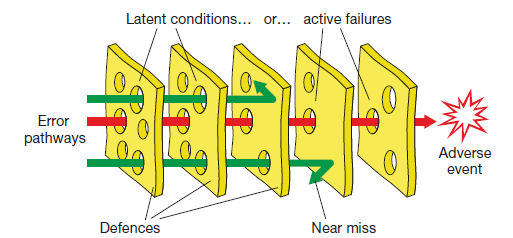
- Active Failures: Direct, frontline errors (e.g., wrong drug administered, wrong-site surgery). These are visible and often immediately linked to the harm.
- Latent Conditions: Hidden system flaws (e.g., poor staffing, inadequate protocols, fatigue, equipment design). These lie dormant until combined with an active error.
🧀 The Swiss Cheese Analogy
Each “slice of cheese” represents a defensive layer - policies, checklists, training, technology, barriers.
But all defenses have holes (weaknesses), created by human error or system flaws.
When holes across layers temporarily align, hazards pass through → an adverse event.
👉 Example: A prescribing error (active failure) + lack of electronic prescribing (latent condition) + inadequate pharmacy staffing → medication harm.
📊 A Systems Approach to Errors
The model shifts focus from “Who is to blame?” (person-centered) to “What in the system allowed this to happen?”.
This systemic perspective has transformed healthcare safety culture.
- 🔎 Most adverse events are systemic: e.g., handover failures, communication gaps, equipment shortages.
- 📝 Learning culture: near misses are as valuable as actual harm cases.
- 📌 Reporting systems: root cause analysis (RCA) and significant event audits (SEA) strengthen defenses.
- 💡 Resilience engineering: healthcare teams design processes anticipating errors (e.g., checklists, double-checks).
🏥 Application in Healthcare
- Medication Safety: multiple defenses (prescribing → pharmacy check → nurse administration → barcoding). Holes align when checks are bypassed.
- Surgery: WHO Surgical Safety Checklist reduces risks by adding layers of defense.
- Diagnostics: delayed cancer diagnoses often involve latent system gaps (delayed results, follow-up failures) combined with human oversight.
- Infection Control: PPE, hand hygiene, and isolation rooms are slices of cheese; alignment of gaps leads to outbreaks.
🌟 Key Lessons
- Errors are rarely due to one person → they are system accidents.
- Strengthening barriers (e.g., electronic prescribing, mandatory timeouts) closes holes.
- Safety requires continuous vigilance - holes can open/shift with staff turnover, new tech, or policy changes.
✅ Conclusion
The Swiss Cheese Model teaches that accidents occur when system flaws + human error align.
By layering defenses and fostering a culture of reporting, learning, and resilience, healthcare can prevent harm and deliver safer patient care.
Doctors should view themselves not just as clinicians, but as guardians of safety systems.
📚 References
