
| Download the amazing global Makindo app: ✅ Means NICE/National Guidelines 2026 compliant Android | Apple | |
|---|---|
| MEDICAL DISCLAIMER: Educational use only. Not for diagnosis or management. See below for full disclaimer. |
Farmer's lung
Related Subjects: |Idiopathic Pulmonary Fibrosis |Diffuse Parenchymal Lung disease |Asbestos Related Lung disease |Sarcoidosis |Coal Worker's Pneumoconiosis |Silicosis |Farmer's Lung |Cryptogenic Organising Pneumonia (COP-BOOP) |Extrinsic Allergic alveolitis (Hypersensitivity) |Pneumoconiosis |Cor Pulmonale
🌾 Farmer’s Lung (a form of Hypersensitivity Pneumonitis / Extrinsic Allergic Alveolitis) is an immune-mediated reaction to inhaled organic antigens. ⚠️ The spores are not infectious - the disease is allergic in origin. 🐦 Bird Fancier’s Lung usually carries a worse prognosis than Farmer’s Lung.
📖 About
- An allergic reaction to inhaled antigens rather than an infection.
- One of the most common occupational interstitial lung diseases in the UK.
- Triggered by microbes (esp. Saccharopolyspora rectivirgula) growing on mouldy hay and crops.
🧪 Aetiology
- Exposure to mouldy hay, straw, or grain (especially in damp, poorly ventilated barns).
- Pesticides (organochlorines, carbamates) may increase susceptibility.
- Moisture + heat → microbial growth → spore release.
🩺 Clinical Features
- Acute: 4–8 hrs post-exposure → dyspnoea, dry cough, fever, chills, malaise, tachycardia.
- Subacute: Ongoing low-level exposure → chronic cough, breathlessness, arthralgia, weight loss.
- Chronic: Years of exposure → progressive dyspnoea, cyanosis, digital clubbing, irreversible fibrosis.
🔍 Investigations
- Bloods: FBC usually normal; CRP/ESR may be ↑.
- Serology: Antigen-specific IgG = supportive evidence.
- PFTs: Restrictive in acute/subacute; mixed restrictive/obstructive in chronic.
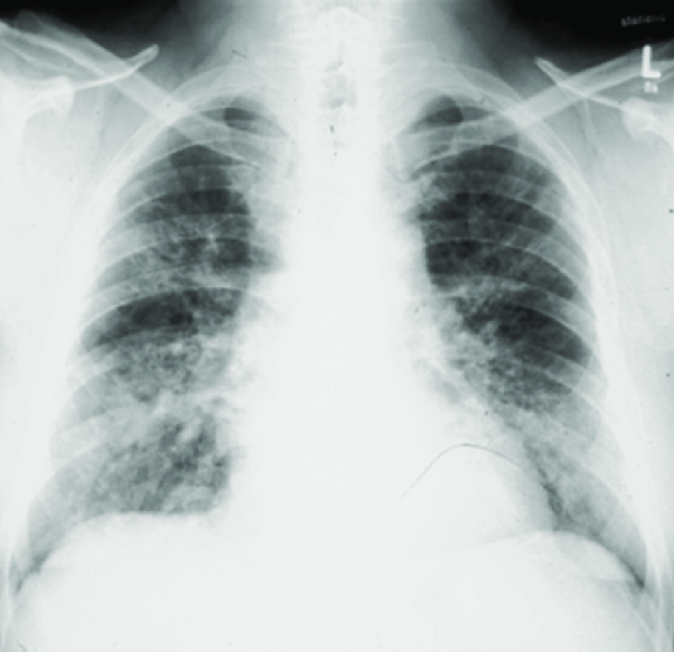
- CXR: Diffuse micronodular shadowing (mid/upper zones). Chronic → fibrosis, volume loss.
- HRCT: Ground-glass opacities, centrilobular nodules, air-trapping; fibrosis in chronic disease.
- BAL: Lymphocytosis with ↓ CD4/CD8 ratio (<1.0).
- Biopsy: Interstitial inflammation ± fibrosis (UIP pattern if advanced).
⚠️ Complications
- Progressive pulmonary fibrosis.
- Respiratory failure (type 1 hypoxaemia).
- Pulmonary hypertension and cor pulmonale.
- Chronic disability if exposure continues.
💊 Management
- Acute: O₂ for hypoxaemia, corticosteroids (prednisolone) in severe cases.
- Chronic/Resistant: Consider steroid-sparing agents (azathioprine, mycophenolate).
- Exposure Control:
- Dry crops thoroughly before storage.
- Maintain good barn ventilation.
- Use protective masks/respirators.
- Prognosis: Early recognition and avoidance of antigen = best outcome.
📚 References
3 Clinical Cases - Farmer’s Lung 🌾🫁
- Case 1 - Acute exposure 🌬️: A 45-year-old dairy farmer develops fever, chills, dry cough, and dyspnoea 6 hours after handling mouldy hay. CXR shows diffuse patchy infiltrates. Symptoms improve on leaving the barn but recur with re-exposure. Teaching: Farmer’s Lung is an acute hypersensitivity pneumonitis due to inhaled thermophilic actinomycetes spores. Acute episodes can mimic pneumonia but improve with antigen avoidance and corticosteroids.
- Case 2 - Subacute presentation 📆: A 52-year-old man presents with weeks of progressive breathlessness and weight loss. HRCT shows ground-glass opacities and centrilobular nodules. Bloods: raised ESR, precipitating antibodies to Saccharopolyspora rectivirgula. Teaching: Subacute Farmer’s Lung presents with insidious symptoms, often misdiagnosed as viral or atypical pneumonia. Diagnosis rests on exposure history, radiology, and immunology. Management is strict antigen avoidance + steroids if persistent.
- Case 3 - Chronic fibrotic disease 🧑🌾: A 60-year-old lifelong farmer has longstanding cough and progressive exertional dyspnoea. HRCT: upper lobe fibrosis, honeycombing, and traction bronchiectasis. PFT: restrictive pattern with reduced DLCO. Teaching: Chronic Farmer’s Lung leads to irreversible interstitial fibrosis if untreated. Prognosis worsens with continued exposure. Early recognition is key - chronic disease may resemble idiopathic pulmonary fibrosis.
| The content on this website is provided for educational and informational purposes only to support exam preparation (e.g., MLA, MRCP, USMLE) and learning. This is NOT medical advice, diagnosis, treatment, or professional guidance. It does not replace consultation with a qualified healthcare professional, official guidelines (e.g., NICE, GMC, BNF), or supervised clinical practice. Always verify information with current, authoritative sources. Makindo and its contributors accept no liability for any reliance on this content, including errors, omissions, or any resulting harm, loss, or consequences. By using this site, you agree to these terms. |
|
|
Categories
- About
- Acute Medicine
- Anaesthetics and Critical Care
- Anatomy
- Anatomy and Physiology
- Biochemistry
- Book
- Cardiology
- Collections
- CompSci
- Crib Sheets
- Critical care
- Dental
- Dermatology
- Differentials
- Drugs
- ENT
- Electrocardiogram
- Embryology
- Emergency Medicine
- Endocrinology
- Ethics
- Foundation Doctors
- GCSE
- Gastroenterology
- General Practice
- Genetics
- Geriatric Medicine
- Geriatrics
- Guidelines
- Haematology
- Hepatology
- Immunology
- Infectious Diseases
- Infographic
- Investigations
- Lists
- MRCP
- Mandatory Training
- Medical Students
- Microbiology
- Nephrology
- Neurology
- Neurosurgery
- Nutrition
- OSCE
- Obstetrics Gynaecology
- Oncology
- Ophthalmology
- Oral Medicine and Dentistry
- Orthopaedics
- Paediatrics
- Palliative
- Palliative Care
- Pathology
- Pharmacology
- Physiology
- Procedures
- Psychiatry
- Public Health
- Radiology
- Respiratory
- Resuscitation
- Revision Topics
- Rheumatology
- Statistics and Research
- Stroke
- Surgery
- Toxicology
- Trauma and Orthopaedics
- USMLE
- Urology
- Vascular Surgery