
| Download the amazing global Makindo app: ✅ Means NICE/National Guidelines 2026 compliant Android | Apple | |
|---|---|
| MEDICAL DISCLAIMER: Educational use only. Not for diagnosis or management. See below for full disclaimer. |
Penetrating Abdominal Trauma ✅
Related Subjects: |Initial Trauma Assessment and Management |Thoracic Trauma Assessment and Management |Flail Chest Rib fractures |Resuscitative Thoracotomy |Haemorrhage control |Traumatic Head/Brain Injury |Traumatic Cardiac Arrest |Abdominal trauma |Tranexamic Acid |Silver Trauma |Cauda Equina
| Phase / Decision Point | Key Actions & Details (NICE NG39 Compliant) 🚑 |
|---|---|
| 1. Immediate Primary Survey 🩺 |
Rapid identification of life threats; pain is a core component of acute abdominal presentation. Restrictive fluids/permissive hypotension in bleeding (1.5 series). |
| 2. Unstable or Hard Signs Present? ⚠️ |
YES → Immediate action 🏃♂️→ Transfer to theatre for damage-control laparotomy 🔪
Do NOT delay for imaging. Limit diagnostics (e.g. FAST) to minimum needed (1.5.29). Negative FAST does NOT exclude injury. |
| 3. Haemodynamically Stable – No Hard Signs ✅ |
CT is preferred in stable patients to detect free fluid, extraluminal contrast/air, active bleeding, or bowel injury. Guides operative vs non-operative path. |
| 4. Definitive Management 🏥 |
NOM is safe in expert centres for selected stable patients (no peritonitis, no instability). NG39 does not prohibit NOM when clinically appropriate. |
| 5. Ongoing Care 👨⚕️ |
Continued monitoring and holistic care post-initial stabilisation. |
Quick Text Summary Flow
Penetrating abdominal trauma + acute pain →
🩺 About
- Penetrating abdominal trauma = injuries from knives, sharp objects, or gunshots.
- Often associated with alcohol intoxication 🍺 and interpersonal violence.
- Liver & spleen = most commonly injured solid organs; bowel & retroperitoneal structures also frequently affected.
- Prognosis generally better than blunt trauma unless major vessel or multi-organ injury occurs.
- Early recognition and rapid intervention are key to survival.
🔎 Clinical Assessment
- ABCDE approach mandatory – airway, breathing, circulation, disability, exposure.
- Assess for shock: tachycardia, hypotension, weak/absent femoral pulses, cool peripheries.
- Inspect chest for associated thoracic injuries (pneumothorax, hemothorax).
- Abdomen: tenderness, guarding, rebound, absent bowel sounds, distension.
- Rectal exam ➝ blood may indicate rectal or lower bowel injury.
- Do NOT remove impaled objects in A&E ❌ – may precipitate massive hemorrhage; leave for controlled surgical removal.
- Serial examination essential in initially stable patients.
🧪 Investigations
- Bloods: FBC, U&E, LFTs, coagulation profile, amylase, group & crossmatch.
- Imaging:
- CXR & AXR – assess for free air, diaphragmatic injury.
- FAST (Focused Assessment with Sonography in Trauma) – detects free fluid/bleeding.
- CT abdomen/pelvis with IV contrast – preferred in stable patients for mapping injury.
- Diagnostic Peritoneal Lavage (DPL): Consider if FAST unavailable. Positive if:
- RBC > 20,000/mm³
- WBC > 500/mm³
- Amylase > 200 U/L
- Bile or faeces present
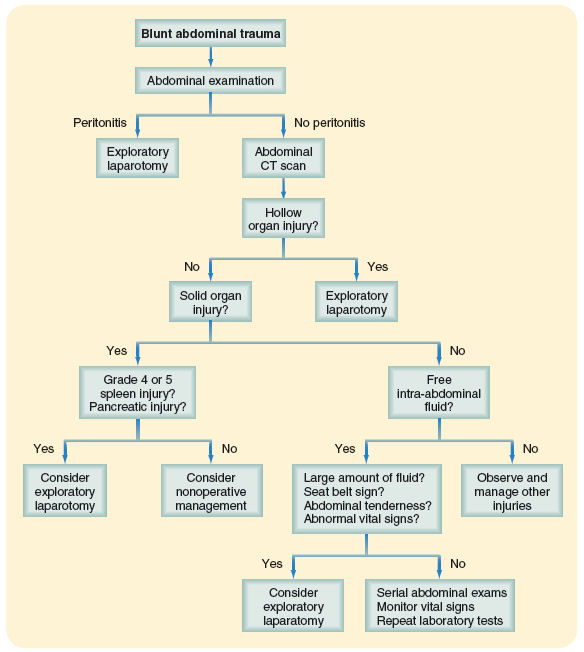
⚡ Emergency Management
- Initial resuscitation: High-flow O₂, 2 × large-bore IV lines, crystalloids ± blood products (damage control resuscitation principles).
- Analgesia & monitoring: Pain relief, continuous vitals, strict urine output monitoring.
- Surgical consult: All penetrating abdominal wounds require urgent evaluation by general/trauma surgery.
- Foreign body management: Never remove impaled objects in ED; allow controlled surgical removal.
- Adjuncts: Nasogastric tube if vomiting/obstruction, catheterisation if haematuria or bladder injury suspected.
🚨 Indications for Immediate Laparotomy
- Persistent hypotension despite adequate resuscitation
- Obvious evisceration of bowel or other viscera
- Signs of peritonitis – rigidity, rebound tenderness, severe tenderness
- Positive FAST or DPL indicating intra-abdominal bleeding
- Gunshot wounds with suspected hollow viscus injury
- Retroperitoneal hematoma expanding in unstable patient
📌 Key Clinical Pearls
- Always examine chest and pelvis – missed injuries are common and lethal.
- Hypotension post-penetrating injury = assume major vascular bleed until proven otherwise.
- Early senior surgical involvement improves survival.
- Damage control surgery may be required in unstable patients (control bleeding, temporary closure, definitive repair later).
- Timely IV antibiotics and tetanus prophylaxis reduce post-operative sepsis.
- Serial examinations, repeat imaging, and multidisciplinary approach (surgery, anaesthetics, intensive care) improve outcomes.
Cases - Penetrating Abdominal Trauma
- Case 1 - Stab Wound with Peritonitis 🗡️ 28-year-old male, knife wound L upper quadrant. Tachycardic, BP 90/60, diffuse tenderness and guarding. FAST: free intra-abdominal fluid. Diagnosis: Penetrating abdominal trauma with haemodynamic instability (likely splenic or visceral injury). Management: Immediate ABC resuscitation, IV fluids + blood products, urgent exploratory laparotomy, IV antibiotics, damage control principles.
- Case 2 - Gunshot Wound with Hollow Viscus Injury 🔫 35-year-old male, right lower abdomen. BP 120/80, abdominal distension, tenderness. CT contrast: pneumoperitoneum, small bowel injury. Diagnosis: Penetrating trauma with small bowel perforation. Management: Exploratory laparotomy, repair or resection + anastomosis, IV broad-spectrum antibiotics, tetanus prophylaxis, post-op monitoring.
- Case 3 - Retroperitoneal Injury 🩺 40-year-old female, stab wound left flank. Haemodynamically stable, flank ecchymosis, haematuria. FAST equivocal. CT: left renal laceration, contained retroperitoneal haematoma. Diagnosis: Penetrating trauma with renal injury. Management: Conservative if stable & contained; surgery if unstable or expanding haematoma; nephrology/surgical follow-up.
Teaching Commentary 🩸
Penetrating abdominal trauma carries high risk for visceral and vascular injury. Key principles: - Unstable patient with peritonitis or positive FAST → immediate laparotomy. - Stable patients → CT with IV contrast for detailed injury mapping. - Common injuries: spleen, liver, bowel, kidney, major vessels. - Early IV antibiotics, tetanus prophylaxis, and blood product resuscitation (damage control) reduce morbidity. - Management balances damage control surgery (rapid hemorrhage & contamination control) with definitive repair once patient stabilised. - Multidisciplinary care (trauma surgery, anaesthetics, ICU, radiology) is essential for optimal outcomes.
📚 References & Guidelines
- NICE Guideline NG39 – Major trauma: assessment and initial management - UK trauma pathways, ABCDE prioritisation, imaging and transfer criteria.
- NICE Clinical Guideline CG174 – Major trauma: service delivery - system and pathway guidance including urgent surgical decision‑making.
- Royal College of Surgeons (RCS) – Guidance on Trauma Outcomes and Standards - UK surgical management and damage control principles.
- Advanced Trauma Life Support (ATLS) Student Course Manual - ABCDE approach, penetrating trauma assessment, indications for laparotomy (widely used in UK practice).
- British Hernia Society / Trauma surgery consensus documents - practical approaches to operative vs non‑operative management.
- Injury Severity Score (ISS) and Trauma Audit & Research Network (TARN) reports - benchmarking epidemiology of penetrating vs blunt trauma in the UK.
- Campbell’s Operative Orthopaedics / Bailey & Love’s Short Practice of Surgery - core surgical textbooks with chapters on penetrating abdominal injuries and damage‑control surgery.
- European Society for Trauma and Emergency Surgery (ESTES) guidelines - evidence and expert consensus on laparotomy thresholds, imaging, sepsis recognition and damage control.
| The content on this website is provided for educational and informational purposes only to support exam preparation (e.g., MLA, MRCP, USMLE) and learning. This is NOT medical advice, diagnosis, treatment, or professional guidance. It does not replace consultation with a qualified healthcare professional, official guidelines (e.g., NICE, GMC, BNF), or supervised clinical practice. Always verify information with current, authoritative sources. Makindo and its contributors accept no liability for any reliance on this content, including errors, omissions, or any resulting harm, loss, or consequences. By using this site, you agree to these terms. |
|
|
Categories
- About
- Acute Medicine
- Anaesthetics and Critical Care
- Anatomy
- Anatomy and Physiology
- Biochemistry
- Book
- Cardiology
- Collections
- CompSci
- Crib Sheets
- Critical care
- Dental
- Dermatology
- Differentials
- Drugs
- ENT
- Electrocardiogram
- Embryology
- Emergency Medicine
- Endocrinology
- Ethics
- Foundation Doctors
- GCSE
- Gastroenterology
- General Practice
- Genetics
- Geriatric Medicine
- Geriatrics
- Guidelines
- Haematology
- Hepatology
- Immunology
- Infectious Diseases
- Infographic
- Investigations
- Lists
- MRCP
- Mandatory Training
- Medical Students
- Microbiology
- Nephrology
- Neurology
- Neurosurgery
- Nutrition
- OSCE
- Obstetrics Gynaecology
- Oncology
- Ophthalmology
- Oral Medicine and Dentistry
- Orthopaedics
- Paediatrics
- Palliative
- Palliative Care
- Pathology
- Pharmacology
- Physiology
- Procedures
- Psychiatry
- Public Health
- Radiology
- Respiratory
- Resuscitation
- Revision Topics
- Rheumatology
- Statistics and Research
- Stroke
- Surgery
- Toxicology
- Trauma and Orthopaedics
- USMLE
- Urology
- Vascular Surgery