
| Download the amazing global Makindo app: ✅ Means NICE/National Guidelines 2026 compliant Android | Apple | |
|---|---|
| MEDICAL DISCLAIMER: Educational use only. Not for diagnosis or management. See below for full disclaimer. |
Leukaemia
Related Subjects: | Leukaemias in General | Acute Promyelocytic Leukaemia | Acute Myeloblastic Leukaemia (AML) | Acute Lymphoblastic Leukaemia (ALL) | Chronic Lymphocytic Leukaemia (CLL) | Chronic Myeloid Leukaemia (CML) | Hairy Cell Leukaemia | Differentiation Syndrome | Tretinoin (ATRA) | Haemolytic Anaemia | Immune Thrombocytopenic Purpura (ITP)
🧬 Leukaemia is a malignant disorder of the blood and bone marrow characterised by uncontrolled proliferation of abnormal white blood cells. This disrupts normal haematopoiesis → causing anaemia, bleeding, and infection. Different types of leukaemia vary in onset, severity, and prognosis, but all require timely recognition and treatment.
📖 Classification of Leukaemia
- Acute Leukaemia ⚡: Rapid progression, accumulation of immature "blast" cells. Requires urgent treatment.
- Chronic Leukaemia 🐢: Slower progression, abnormal but more mature cells, often discovered incidentally.
- Myeloid Leukaemia 🩸: Involves granulocytes, RBCs, or platelets derived from myeloid stem cells.
- Lymphocytic Leukaemia 🛡️: Involves lymphocytes (B, T, NK cells) derived from lymphoid stem cells.
🔬 Myeloid vs Lymphoid Lineage
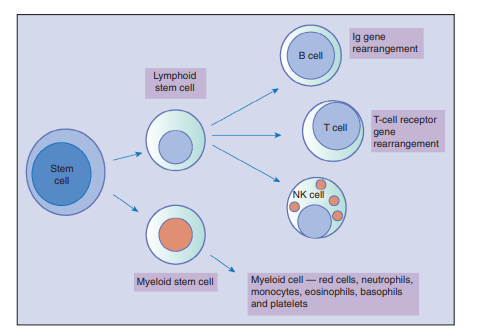
- Lymphoid stem cell: B cells, T cells, NK cells
- Myeloid stem cell: RBCs, Platelets, Neutrophils, Monocytes, Eosinophils, Basophils
🧾 Types of Leukaemia
- Acute Lymphoblastic Leukaemia (ALL) 👶 – Most common in children, but also seen in adults.
- Acute Myeloid Leukaemia (AML) 🧓 – More common in adults, rapid onset, associated with myeloid blasts.
- Chronic Lymphocytic Leukaemia (CLL) 👴 – Commonest adult leukaemia in the West, slow progression.
- Chronic Myeloid Leukaemia (CML) 📉 – Driven by the Philadelphia chromosome (BCR-ABL), progresses through chronic → accelerated → blast crisis phases.
📊 Incidence and Notes
| Type | Incidence | Notes |
|---|---|---|
| ALL 👶 | ~9% | Most common childhood leukaemia; rapid progression if untreated. |
| CML 📉 | ~10% | Adults; linked to Philadelphia chromosome; average age ~64 yrs. |
| CLL 👴 | ~23% | Slow buildup of abnormal B cells; commonest leukaemia in elderly. |
| AML 🧓 | ~27% | Bone marrow packed with myeloid blasts; most cases >50 yrs. |
| Myeloproliferative Disorders 🔄 | ~31% | Include polycythaemia vera, myelofibrosis, essential thrombocythaemia. |
⚠️ Signs & Symptoms
- Fatigue, weakness, pallor (anaemia) 😴
- Frequent or severe infections 🤒
- Easy bruising, bleeding, petechiae 🩸
- Unexplained weight loss ⚖️
- Bone or joint pain 🦴
- Swollen lymph nodes or splenomegaly 🫁
🧪 Diagnosis
- Blood tests: Abnormal WBC, anaemia, thrombocytopenia.
- Bone marrow aspiration/biopsy: Confirms leukaemic blasts.
- Flow cytometry: Immunophenotyping to classify lineage.
- Genetic tests: e.g. BCR-ABL in CML, FLT3 in AML.
- Imaging: CT/ultrasound for lymphadenopathy or organomegaly.
📚 High-Yield Revision Summary
| Category | Key Facts |
|---|---|
| 🔬 Definition | Malignant proliferation of abnormal WBCs in bone marrow → disrupts normal haematopoiesis (anaemia, infection, bleeding). |
| 📖 Classification |
|
| 🧾 Common Types |
|
| ⚠️ Symptoms |
|
| 🧪 Key Investigations |
|
| 💊 Management |
|
| 📈 Prognosis |
|
💡 Exam Tip: Think “Anaemia, Infection, Bleeding” as the classic triad of leukaemia presentation. Always mention bone marrow biopsy for diagnosis and TKIs for CML in finals!
💊 Treatment Options
- Chemotherapy 💉: First-line for acute leukaemias.
- Targeted therapy 🎯: e.g. Imatinib for CML (BCR-ABL tyrosine kinase inhibitor).
- Immunotherapy 🛡️: CAR-T therapy, monoclonal antibodies (rituximab in CLL).
- Radiotherapy ☢️: For localised disease or CNS prophylaxis.
- Stem cell transplant 🌱: Potentially curative in high-risk/relapsed cases.
- Supportive care 🤲: Transfusions, antibiotics, growth factors.
📈 Prognosis
Prognosis depends on type, age, and cytogenetics. ✅ Childhood ALL – cure rates >80%. ✅ CML – near-normal life expectancy with tyrosine kinase inhibitors. ⚠️ AML in elderly – poorer prognosis, but improving with novel therapies. Overall, advances in precision medicine and stem cell transplantation continue to improve survival outcomes.
| The content on this website is provided for educational and informational purposes only to support exam preparation (e.g., MLA, MRCP, USMLE) and learning. This is NOT medical advice, diagnosis, treatment, or professional guidance. It does not replace consultation with a qualified healthcare professional, official guidelines (e.g., NICE, GMC, BNF), or supervised clinical practice. Always verify information with current, authoritative sources. Makindo and its contributors accept no liability for any reliance on this content, including errors, omissions, or any resulting harm, loss, or consequences. By using this site, you agree to these terms. |
|
|
Categories
- About
- Acute Medicine
- Anaesthetics and Critical Care
- Anatomy
- Anatomy and Physiology
- Biochemistry
- Book
- Cardiology
- Collections
- CompSci
- Crib Sheets
- Critical care
- Dental
- Dermatology
- Differentials
- Drugs
- ENT
- Electrocardiogram
- Embryology
- Emergency Medicine
- Endocrinology
- Ethics
- Foundation Doctors
- GCSE
- Gastroenterology
- General Practice
- Genetics
- Geriatric Medicine
- Geriatrics
- Guidelines
- Haematology
- Hepatology
- Immunology
- Infectious Diseases
- Infographic
- Investigations
- Lists
- MRCP
- Mandatory Training
- Medical Students
- Microbiology
- Nephrology
- Neurology
- Neurosurgery
- Nutrition
- OSCE
- Obstetrics Gynaecology
- Oncology
- Ophthalmology
- Oral Medicine and Dentistry
- Orthopaedics
- Paediatrics
- Palliative
- Palliative Care
- Pathology
- Pharmacology
- Physiology
- Procedures
- Psychiatry
- Public Health
- Radiology
- Respiratory
- Resuscitation
- Revision Topics
- Rheumatology
- Statistics and Research
- Stroke
- Surgery
- Toxicology
- Trauma and Orthopaedics
- USMLE
- Urology
- Vascular Surgery